
Texas has one of the lowest divorce rates in the U.S., especially given its large population. The crude divorce rate is typically between 1.4 and 2.1 divorces per 1,000 residents. This is well below the national average. The rate has been steadily declining over time, indicating strong marital stability. Apparently, Texans prefer long marriages over longhorns.
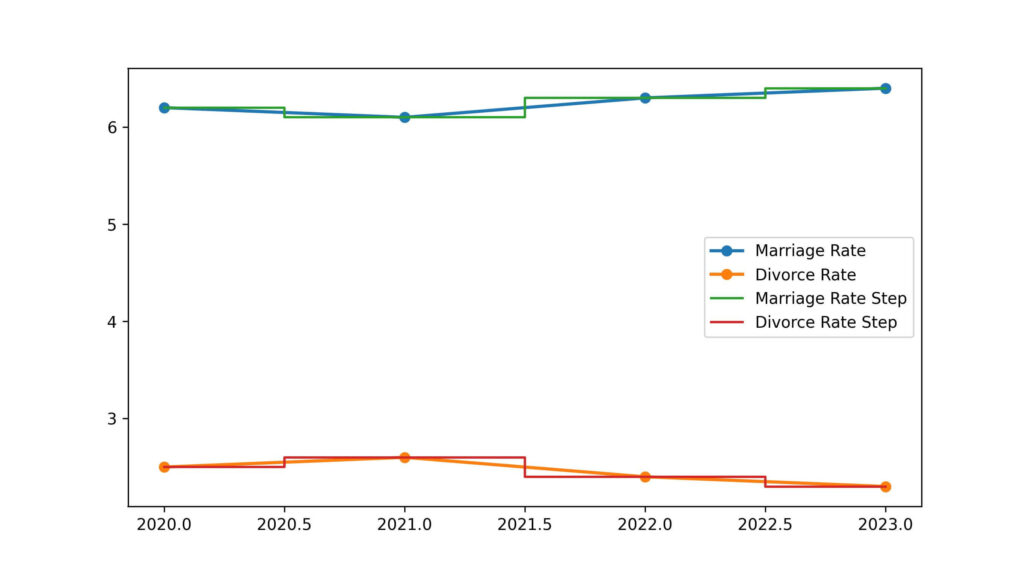
The median length of marriage in Texas is about 17.5–17.6 years. This includes both ongoing and ended marriages. So, Texans call it quits a bit sooner—just enough time to enjoy a few BBQs together.
| Age Group (Years) | U.S. Divorce Rate per 1,000 Married Women (2021) | Key Texas/National Trend Observations | Texas Overall Divorce Rate (Recent Estimates) |
|---|---|---|---|
| < 25 | 19.7 (15–24 Group) | Highest risk nationally. Younger couples, especially those married before 25, still face the greatest risk of divorce. | 1.4 per 1,000 total population (Crude Rate, 2021) |
| 25–34 | 16.3 | High rate, though declining as Texans, on average, are marrying later (median age ≈ 27 for women). | Refined Rate (2023): Texas’s adjusted rate is consistently below the national average of 14.4 |
| 35–49 | 14.9 (35–44 Group) | Divorce is less common than for younger groups, but marriages that last the median duration (around 8 years) often end in this age bracket. | |
| 50 and older | 10.3 (Refined 50+ rate) | Gray Divorce Trend. The divorce rate among Texans aged 50+ has steadily increased, often ending long-term marriages. | |
| Overall Rate (All Ages) | 2.5 per 1,000 total population (U.S. Crude Rate, 2021) | Texas Crude Rate: Has dropped dramatically from a high of 5.5 in 1990 to 1.4 in 2021, one of the lowest in the U.S. |
Divorce Rate in Texas in 2025
- Low Crude Divorce Rate: Despite its large and diverse population, Texas’s divorce rate is below the national average and has been steadily declining since the 1980s.
- No-Fault Divorce Dominates: Most divorces cite “Insupportability” due to discord or conflict of personalities. Because apparently, blaming personalities is easier than paperwork.
- Mandatory 60-Day Waiting Period: Texas requires a 60-day “cooling-off” period from filing to final decree, except in cases of family violence. No skipping ahead, even if both parties are eager.
- Fault Still Matters: Adultery, cruelty, and felony convictions can affect property division. Yes, proving someone’s guilty can actually pay off – literally.
- Community Property State: Texas presumes that most property and debts acquired during marriage are jointly owned and divisible.
- “Just and Right” Standard: Judges can deviate from a 50/50 split based on factors like fault, earning disparities, or child custody. Apparently, fairness is subjective in Texas courts.
- Women Initiate Most Divorces: Women file about 69% of divorce cases in Texas, aligning with national trends.
- High Cost of Divorce: Divorce can be expensive in Texas, often ranking among the highest in the nation.
Divorce Rate in Texas in 2024
- Low Crude Divorce Rate: Texas has a relatively low divorce rate, around 1.3–1.5 per 1,000 residents, placing it below the national average and among the lowest in the U.S.
- Decade-Long Decline: Divorce rates have steadily dropped since the 1980s, thanks to Texans marrying later and fewer people marrying overall. Apparently, waiting longer really does pay off… in staying married.
- No-Fault Divorce (“Insupportability”): Most divorces cite “insupportability,” meaning irreconcilable conflict destroys the marriage. This is the quickest, least adversarial route.
- Mandatory 60-Day Waiting Period: Texas requires a 60-day “cooling-off” period from filing to final decree, only waivable in cases of family violence. Because rushing a divorce is just too exciting, apparently.
- Community Property State: Texas law assumes all assets and debts acquired during marriage are jointly owned and divided 50/50.
- Fault Still Matters: Grounds like adultery, cruelty, and abandonment can influence property division, allowing a judge to award more than 50% to the “innocent” spouse. Nothing says fairness like proving who’s guiltier first.
- Women Initiate Most Divorces: About 69% of divorces are initiated by women, often linked to unequal domestic responsibilities.
- Legislative Push to End No-Fault: In 2024, lawmakers debated ending no-fault divorce, but proposals failed. Couples still don’t have to prove fault to separate.
Divorce Rate in Texas in 2023
- Low Crude Divorce Rate: Texas’s crude divorce rate was about 2.7 per 1,000 residents in 2023, slightly below the national average and among the lowest in the U.S.
- Most Divorces Filed by Women: Around 70% of divorce petitions were initiated by women. Because clearly, someone has to do the heavy lifting of ending marriages.
- Mandatory 60-Day Waiting Period: A 60-day “cooling-off” period is required before a divorce can be finalized, with exceptions only for family violence. Patience is mandatory – Texas style.
- Most Common Grounds – No-Fault “Insupportability”: Most divorces cite irreconcilable conflict with no reasonable expectation of reconciliation.
- Fault Still Recognized: Texas allows six fault-based grounds, including adultery and cruelty. So yes, guilt still counts if you want a bigger slice of the property pie.
- Fault Can Affect Property Division: Texas is a Community Property state (50/50 by default), but judges can award a larger share to the “innocent” spouse if fault is proven.
- Residency Requirement: To file in Texas, a spouse must have lived in the state for at least six months and in the filing county for at least 90 days.