
Divorce Rates in America: Current Statistics, Causes, and Cultural Shifts
Divorce still plays a big role in American family life, whether people like to admit it or not. In 2023, more than 1.8 million Americans called it quits, and about one-third of everyone who has ever married has already been through at least one divorce. Most don’t stay single for long – about 66% remarry – and nearly half of those remarried couples end up having kids together, proving that starting over is basically a national hobby.
What Percentage of Us Marriages End in Divorce?
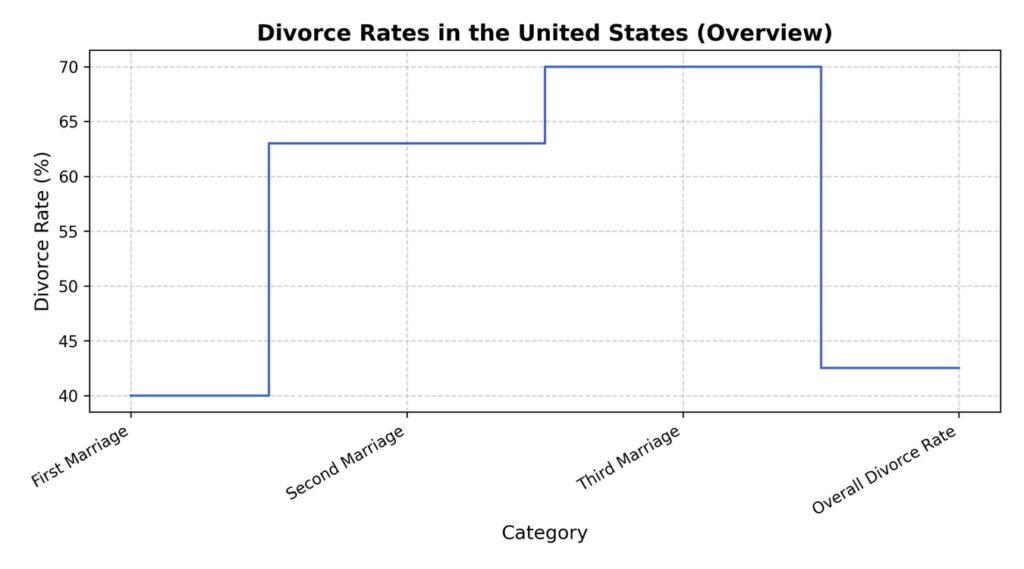
Recent studies show that about 40 percent of first marriages in the United States end in divorce. That means most couples stay together, even if it does not always feel that way when you look around.
Second marriages are another story. Those have a much higher breakup rate, landing somewhere around 60 to 67 percent. When people bring kids, money stress, or old baggage into a new marriage, the odds don’t exactly improve. By the time someone reaches a third marriage, well… let’s just say the numbers aren’t getting kinder.

Divorce rates have also dropped for younger couples. Many people wait longer to get married, think it through more, and shockingly, that helps. The idea that every marriage is doomed from the start is outdated, even if it makes for a catchy joke.
So what’s the simple answer? Around 40 to 45 percent of marriages in America end in divorce. Not half. Not “almost everyone.” Just a bit under half, with the rate changing based on age, money, and whether it’s a first or second trip down the aisle.
Divorce Statistics in America: What the Numbers Really Show
Divorce was at its highest point in the early 1980s. Since then, the rate has dropped, even though many people still believe the opposite. Younger couples today wait longer to get married, and that choice seems to help. Their divorce rate is lower than the rate of couples who married in past decades. This long-term shift is easy to see when you look at the year-by-year data.
The divorce rate in the United States has long been a topic of interest and concern, reflecting the changing dynamics of relationships, societal shifts, and evolving cultural norms. As we delve into the available statistics, we gain a comprehensive view of the trends and insights surrounding this complex issue.
Different groups have different outcomes. First marriages end about 40 percent of the time, which is not great but not the disaster people imagine. Second marriages fall apart even more often, thanks to kids, money stress, and old baggage that does not magically disappear. These charts show those patterns without the usual noise.
You will also notice how divorce rates react to major events. Tough economic years push the numbers up. Stable years bring them down. Big social changes leave their mark too. When you see the trends laid out on a graph, it’s easier to understand how each decade shaped marriage in the United States.
Divorce Rate in America 2025 Trends
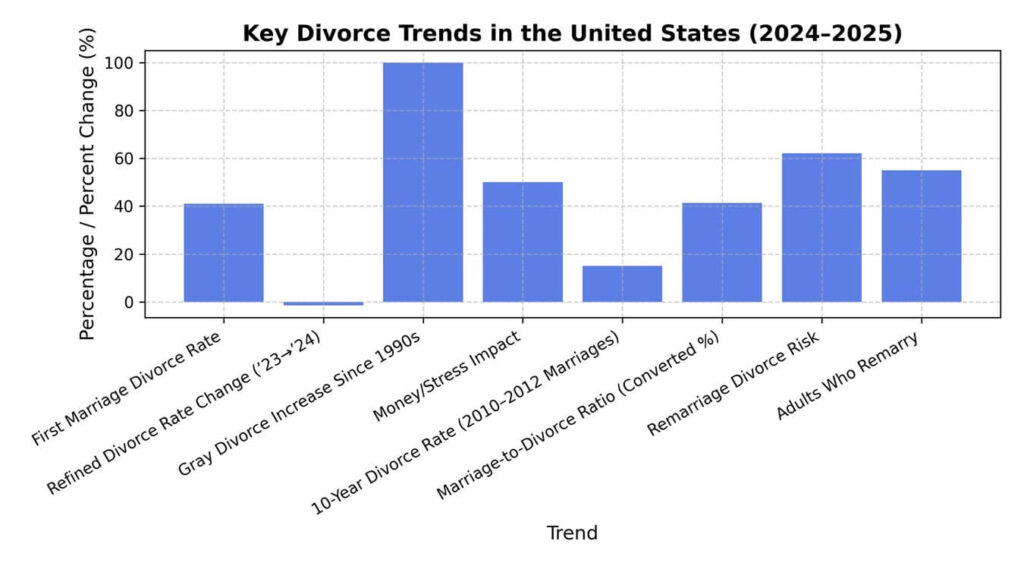
Overall divorce rate is declining: About 41% of first marriages end in divorce, lower than the old “50%” estimate.
Refined divorce rate: In 2024, the refined divorce rate was 14.2 divorces per 1,000 married women, down slightly from 14.4 in 2023.
Gray divorce: Divorce among couples 50+ is increasing, having more than doubled since the 1990s, as people live longer and prioritize happiness.
Money and stress: Financial problems, high-stress jobs, and debt remain major contributors to divorces, while steady jobs and higher education help marriages last.
Long-term marital stability: Only ~15% of marriages formed in 2010–2012 had ended in divorce after 10 years, showing that recent first marriages are stronger.
Marriage-to-divorce ratio: In 2024, there were 2,390,482 marriages and 986,810 divorces, giving a ratio of 2.42 marriages per divorce.
Younger generations: Millennials and Gen Z marry later, leading to more stable marriages due to maturity and financial stability.
Median age at first divorce is rising: Men around 30.2 years, women around 28.4 years, reflecting older, more prepared couples.
Remarriages: Second or third marriages have a higher risk of divorce (over 60%), often due to blended families and leftover financial issues. About 55% of divorced adults eventually remarry.
Overall trend: Marriage is more stable for young first-time couples, but still challenging for older adults and remarried individuals.
Divorce Rate in America 2024 Trends
Overall trend: Divorce numbers are dropping; marriage is changing, with the refined divorce rate at 14.2 per 1,000 married women, down from 14.4 in 2023.
Younger adults: Waiting longer to marry, often financially and emotionally more prepared, leading to stronger marriages. Millennials and Gen Z are finishing school, getting steady jobs, and marrying older.
Gray divorce: Divorce among adults 50+ continues to rise, particularly ages 55–64. Many older couples prioritize happiness over staying in unhappy marriages.
Remarriages: About 60% of second marriages end in divorce within 10 years due to blended-family challenges, past habits, and financial issues.
State variation: Divorce risk differs across states. For example, Washington D.C. had a marriage-to-divorce ratio of 3.77, while Delaware’s was only 1.44, showing location matters.
Money stress: High costs for food, housing, and debt remain top reasons for breakups. Nearly 1 million divorces occurred in 2024, highlighting ongoing financial strain. Steady work and low debt help marriages survive.
Divorce Rate in America 2023 Trends
The overall divorce rate hit a historic low in 2023 and continued slightly declining into 2024 and 2025. About 41% of first marriages end in divorce by 2025.
The refined divorce rate in 2023 was 14.4 divorces per 1,000 married women, dipping slightly to 14.2 per 1,000 in 2024.
First marriages show higher divorce rates among younger adults: 18–29-year-old men have 17.6 per 1,000 and women 19.3 per 1,000.
“Gray divorce” (50+ adults) continues to rise; the rate has more than doubled since 1990, driven by Baby Boomers and older couples seeking happiness in later years.
In 2024, there were 2,390,482 marriages and 986,810 divorces, giving a marriage-to-divorce ratio of 2.42 (slightly up from 2.38 in 2023).
Second marriages are much less stable: about 60% end in divorce, and the ten-year survival rate for second marriages is roughly 45%. Divorce risk is higher for those marrying in their mid-20s to mid-30s in second marriages, reaching up to 72% in some datasets.
Median duration of marriage before divorce in 2023 was 12 years, up from 10 years in 2008.
High costs of living, including rent, food, and debt, remain top causes of divorce, while steady jobs, higher education, and financial stability help marriages last.
What Is the #1 Thing That Destroys Marriages?
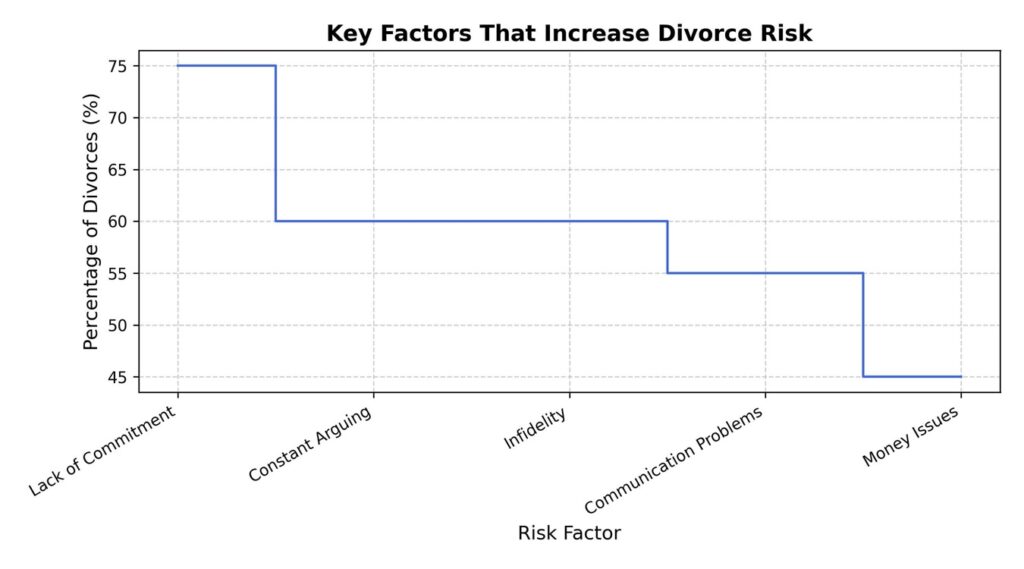
#1 Cause – Lack of Commitment: Cited by 73-75% of divorcing couples. Involves stopping effort to maintain the marriage or prioritizing other aspects of life (work, hobbies, friends) over the relationship. To explain it more simple, it is when one or both partners stopped putting in the effort, got distracted by work, hobbies, or friends, and basically forgot they were supposed to be married.
Other heavy hitters:
Infidelity
Cheating ruins trust – no surprise there. Cited by 55–60% of divorces.
Too Much Arguing
Constant fights, unresolved conflict, or just plain nasty communication can do in 56–58% of marriages.
Money Problems
Debt, spending disagreements, or mismatched financial goals stress couples to the breaking point.
Poor Communication
When couples stop talking (or just yell without listening), misunderstandings pile up and resentment sets in – fertile ground for divorce.
Who Is the Initiator of Divorce?
In most heterosexual marriages, it’s the wife who calls it quits – about 70% of divorces are started by women. Men, meanwhile, seem fine coasting along. In non-married couples, breakups are split evenly, so clearly marriage hits women differently.
Why? First, emotional labor. Women often do all the feeling-checking, problem-solving, and “keeping the marriage alive” work. If their partner isn’t pitching in, they get drained – and eventually, done.
Second, household roles. Women now work outside the home, but somehow still do most chores and childcare. Juggling a career and a full house? No wonder they leave.
Money matters too. Today, women can support themselves. Unlike decades ago, they don’t have to stay stuck in a bad marriage just to pay the bills.
And let’s be honest: women have less patience for nonsense. Cheating, emotional abuse, or a partner who never admits they’re wrong? That’s a fast track to divorce. Friends are consulted, plans are made, and the decision is made.
What Are the Hardest Years of Marriage?
Marriage has its trouble spots, and some years are worse than others. The first year or two is rough. Reality hits after the wedding hype. Suddenly, you’re stuck together all the time, arguing over habits, bills, and who left socks on the floor. Romance takes a back seat, and if you haven’t learned to fight without wrecking the relationship, the first big argument can feel like the end.
The next big danger zone is around five to eight years – the infamous “seven-year itch.” Kids arrive, sleep disappears, money disappears, and your partner starts to feel more like a roommate than a lover. Some people lose sight of their own goals or who they even are. Routine and boredom kick in, and intimacy often drops to almost zero. Not surprisingly, this is when most divorces happen.
Then there’s the late-life shock, often twenty years in or more. Kids leave, and suddenly you’re face-to-face with your spouse for the first time in decades. Maybe you realize you have nothing in common besides raising children. People live longer now, and many decide they won’t waste decades in a boring or unhappy marriage. Hence, the rise of “gray divorce.”
Factors That Influence Divorce Risk
Divorce usually isn’t about one thing. It’s a mix of problems inside the marriage and outside stress that makes everything worse. Money troubles, job pressure, or family drama can turn small annoyances into huge fights.
The top killer is lack of commitment. About three out of four people blame it. It’s not a single event – it’s the slow fade. Effort drops, priorities shift, and suddenly your spouse isn’t number one anymore.
Constant arguing is another red flag. It’s not what you fight about – it’s how. Unresolved fights build resentment fast, turning your home into a tension factory.
Cheating? That’s usually game over. Around 60% of divorces involve infidelity. Once trust is broken, repairing it is a long shot. Communication problems make everything worse. Avoiding talks, being hostile, or giving the silent treatment only grows distance. Small problems snowball when no one talks honestly.
Money fights are classic too. It’s not the amount, it’s how you handle it. Different spending habits, debt, or hiding money creates tension that rarely goes away.