
Tennessee’s divorce rate ranks high compared to other U.S. states. The crude divorce rate is about 2.9 to 3.2 divorces per 1,000 residents. The refined rate, accounting for married women specifically, places the state in the top 10 to 15 nationally. This indicates a higher level of marital dissolution than most states. Clearly, Tennesseans are just keeping the divorce industry busy.
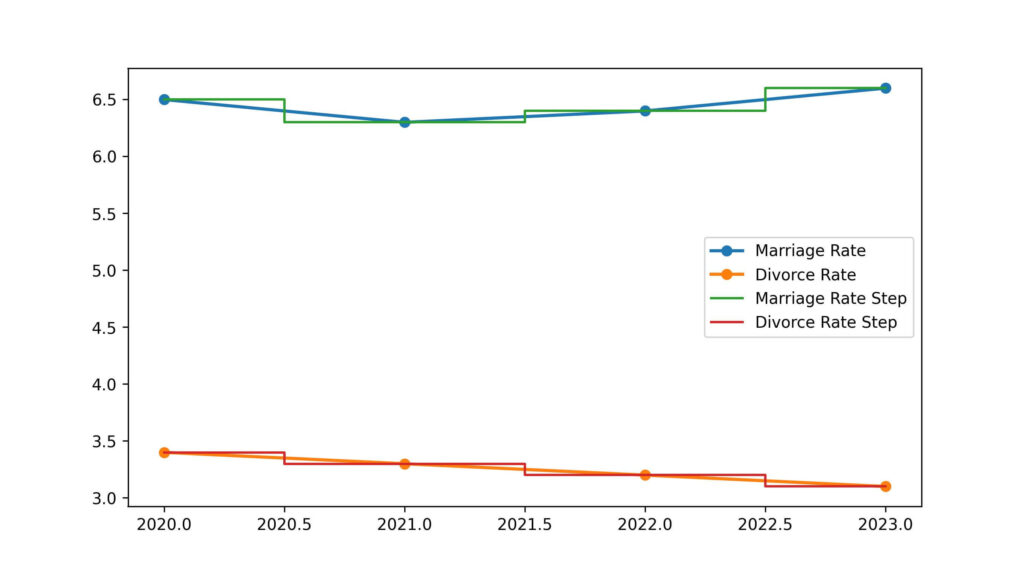
The median length of marriage in Tennessee is about 20.1 years. This includes both ongoing and ended marriages. So, Tennesseans barely outlast the national average – long enough to remember their wedding playlist, but not much else.
| Age Group (Years) | U.S. Divorce Rate per 1,000 Married Women (2021) | Key Tennessee/National Trend Observations | Tennessee Overall Divorce Rate (Recent Estimates) |
|---|---|---|---|
| 15–24 | 19.7 | Highest rate nationally — risk is highest for those who marry young, a factor often associated with Tennessee’s higher rates. | 3.3 per 1,000 total population (Crude Rate, 2021) |
| 25–34 | 16.3 | High rate. Nationally, 60% of all divorces involve individuals aged 25–39. | High ranking: Tennessee is historically ranked in the top 10 states for divorce rate |
| 35–44 | 14.9 | Marriages that last the median duration (around 8 years) often end in divorce for individuals in this age bracket. | |
| 45–54 | 14.1 | Stable rate, slightly lower than younger groups. | Refined rate context: Tennessee’s refined rate is significantly higher than the national average |
| 55–64 | 11.8 | Part of the “Gray Divorce” trend; the rate for this older group has risen significantly since 1990. | |
| 65 and older | 5.5 | Lowest rate, but fastest-growing demographic for divorce since 1990. |
Divorce Rate in Tennessee in 2025
- Consistently High Divorce Rate. Tennessee often ranks in the top 10–15 states for divorce, partly due to slightly higher poverty rates and lower median household income – because financial stress is such a fun marriage enhancer.
- Minimal Separation Required Before Filing. No mandatory separation is needed before filing the initial Complaint for Divorce. Who needs a timeout when you can jump straight into court drama?
- Mandatory Cooling-Off Period
- 60 days if there are no minor children
- 90 days if children under 18 are involved
- “Hybrid” Grounds State with 15 Options. Tennessee allows 15 statutory grounds for divorce – 13 fault-based, plus the no-fault “Irreconcilable Differences” option. Because nothing says “choice overload” like 15 ways to end your marriage.
- Fault Still Matters for Money. Even though most cite “Irreconcilable Differences,” fault (e.g., adultery) can influence alimony decisions.
- Adultery Has an Immediate Consequence. Committing adultery may prevent a dependent spouse from receiving alimony. So yes, cheating can ruin your wallet too – multi-tasking at its finest.
- Equitable Distribution Is the Rule. Marital assets and debts are divided “justly and reasonably,” but not necessarily 50/50.
- The Re-Marriage Ban. After the final decree, neither party can remarry for 30 days (the statutory appeal period).
Divorce Rate in Tennessee in 2024
- Above-Average Crude Divorce Rate. Tennessee’s divorce rate was about 2.9 per 1,000 residents, above the national average of 2.5.
- Hybrid Grounds State (15 Legal Options). Tennessee recognizes 15 divorce grounds – 13 fault-based (e.g., adultery, extreme cruelty) plus the no-fault “Irreconcilable Differences.” Because why settle for one easy reason when you can choose from 15?
- Uncontested Divorce Requires Full Agreement. For a no-fault divorce, spouses must agree on property, custody, and alimony. Disagreement forces proof of fault in court.
- Short Mandatory Waiting Period
- 90 days if minor children are involved
- 60 days if no minor children
Patience is a virtue… unless you have no kids, then hurry up already.
- Fault Impacts Financial Outcomes. Adultery, abandonment, or other faults can influence alimony and equitable distribution, potentially creating unequal financial outcomes.
- Four Types of Alimony
- Rehabilitative: Helps a spouse become self-sufficient
- Transitional: Assists adjustment to single life
- Alimony in solido: Lump-sum, non-modifiable
- Alimony in futuro: Long-term/periodic support
Because nothing says “smooth breakup” like four flavors of spousal support.
- New Laws Emphasize Co-Parenting (2024). Updated laws encourage shared decision-making, structured parenting plans, and active involvement of both parents.
- Equitable Distribution Is Not 50/50. Marital property is divided fairly but not necessarily equally. Judges consider marriage length, finances, and contributions (including homemaking).
Divorce Rate in Tennessee in 2023
- High Crude Divorce Rate. Tennessee’s divorce rate was about 2.9 per 1,000 residents, above the national average of 2.5. Higher marriage rates partly explain the higher divorce numbers.
- Top 10 Nationally. Tennessee often ranked 10th in the nation for divorce, tying with Kentucky and Mississippi. Because nothing screams “marriage capital” like making the top 10 in divorces.
- Shortest Waiting Period (No Children). For no-fault divorces without minor children, the mandatory waiting period is 60 days.
- Longer Waiting Period (With Children). Divorces with minor children require a 90-day wait, and parents usually attend a parenting class. Ah yes, a little extra waiting and schooling – because divorce isn’t stressful enough already.
- Hybrid Grounds State. Tennessee recognizes many fault grounds (adultery, extreme cruelty, desertion, habitual drunkenness) alongside the no-fault “Irreconcilable Differences.”
- Mutual Consent Required for No-Fault Divorce. Both spouses must agree to a no-fault divorce; otherwise, the filing spouse must prove fault in court. Nothing like forcing couples to agree or drag each other through court – fun times!
- Fault Can Affect Alimony. While property division follows Equitable Distribution, fault may influence whether and how much alimony is awarded.
- Six-Month Residency Requirement. At least one spouse must have lived in Tennessee for six months before filing for divorce.