
South Dakota’s divorce rate is generally low to moderate compared to other states. The crude divorce rate is typically between 2.3 and 2.6 divorces per 1,000 residents. This places the state near or slightly below the national average. Recent data suggests it’s the lowest rate reported in decades. Apparently, South Dakotans are either very committed or just really good at keeping quiet about their problems.
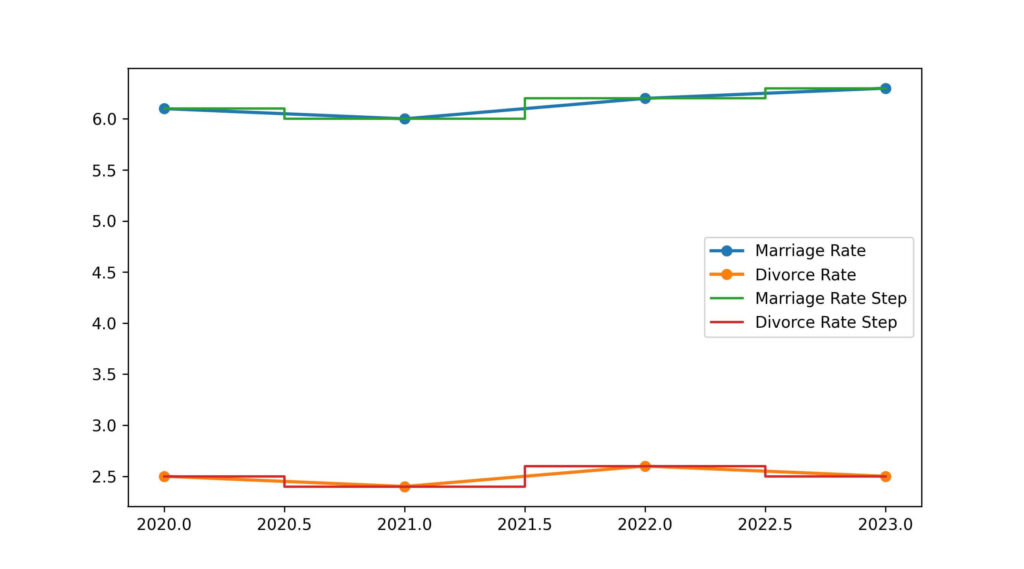
The median length of marriage in South Dakota is about 21.8 years. This includes all ongoing marriages, which raises the average. So, South Dakotans really know how to stick it out – long enough to forget what single life was like.
| Age Group (Years) | U.S. Divorce Rate per 1,000 Married Women (2021) | Key South Dakota/National Trend Observations | South Dakota Overall Divorce Rate (Recent Estimates) |
|---|---|---|---|
| 15–24 | 19.7 | Highest rate nationally — divorce is most likely for those who marry young. | 20.1 per 1,000 married women (Refined Rate, 2023). NOTE: This is an unusually high recent estimate. |
| 25–34 | 16.3 | High rate, though rates are generally dropping for younger generations nationally. | 2.5 per 1,000 total population (Crude Rate, 2021) |
| 35–44 | 14.9 | Marriages that last the median duration (8–10 years) often end in divorce for this age bracket. | Lowest Crude Rate Since 1972 (2.5 per 1,000 in 2021) |
| 45–54 | 14.1 | Stable rate, slightly lower than younger groups. | Median duration of marriage before divorce in SD is 9 years (2021) |
| 55–64 | 11.8 | Part of the “Gray Divorce” trend; the rate for this older group has risen significantly since 1990. | |
| 65 and older | 5.5 | Lowest rate, but fastest-growing demographic for divorce since 1990. |
Divorce Rate in South Dakota in 2025
- Below National Average Rate: South Dakota’s crude divorce rate is typically under the national average, around 2.5 per 1,000 residents, reflecting moderate marital stability.
- “Divorce Mill” History: Sioux Falls earned fame as a “divorce colony” in the late 19th and early 20th centuries due to short residency requirements. Apparently, quick divorces were the state’s claim to fame before tourism.
- Mixed Grounds for Divorce: The state retains multiple fault grounds – adultery, extreme cruelty, willful neglect, habitual intemperance, felony conviction—but the most common is no-fault “irreconcilable differences.”
- No-Fault Requires Consent (or Default): Both spouses must agree to a no-fault divorce, or the respondent must not appear; otherwise, one of the seven fault grounds must be proven. So much for an easy “no-fault” divorce – consent is apparently a full-time job.
- Mandatory 60-Day Waiting Period: Divorces cannot be finalized until at least 60 days after the summons is served.
- Equitable Distribution: Marital property is divided fairly, not necessarily equally, based on factors like marriage length, age, health, and earning capacity. Because who doesn’t love a little legal math to decide who gets grandma’s vase?
- Residency Requirement: The filing spouse must be a South Dakota resident (or military stationed there), often interpreted as at least 60 days before the final decree.
- Early Marriages Ending: Most divorces occur after relatively short marriages – commonly two to three years.
Divorce Rate in South Dakota in 2024
- Slightly High Refined Divorce Rate: The refined divorce rate (divorces per 1,000 married women) was about 17.8, above the national rate of 14.2, showing relatively high marital instability.
- Controversial Legislative Effort: House Bill 1254 aimed to eliminate “irreconcilable differences” as a divorce ground, effectively ending no-fault divorce – but it failed. Because who doesn’t want to make divorces legally harder for everyone?
- Hybrid Grounds State: South Dakota allows both no-fault and fault-based divorces. No-fault “irreconcilable differences” is most common (often requiring consent), but six fault grounds remain: adultery, extreme cruelty, willful desertion, habitual intemperance, etc.
- Mandatory 60-Day Waiting Period: Divorce papers must be served at least 60 days before the court can finalize the case, applying to both contested and uncontested divorces. Nothing says “take your time” like a mandatory two-month cooling-off period.
- Fault Ignored for Property & Custody: Judges cannot consider marital fault when dividing property or determining child custody; decisions are based solely on fairness and the child’s best interests.
- Fault CAN Affect Alimony: Judges may consider a spouse’s fault in causing the marriage to end when awarding spousal support. Because nothing says “fairness” like guilt-based cash awards.
- Short Residency Requirement: To file, one spouse must have been a South Dakota resident for only 60 days before filing.
Divorce Rate in South Dakota in 2023
- Low Crude Divorce Rate: The crude divorce rate was about 2.3 per 1,000 residents, below the national average of 2.4–2.5, indicating relatively stable marriages.
- High Marriage Rate: Despite fewer divorces, South Dakota reported around 17.8 marriages per 1,000 people (ages 15+), showing a highly matrimonial-friendly population. Because apparently, more weddings magically mean fewer divorces.
- No Residency Waiting Period Before Filing: One only needs to be a resident in “good faith” at filing and remain so until the divorce is finalized – no long waiting required.
- Mandatory 60-Day Waiting Period: Courts cannot finalize a divorce until at least 60 days after the summons is served. Nothing like a mandatory two-month “cooling-off” to keep emotions simmering.
- Dual-Grounds State (Fault and No-Fault): South Dakota allows no-fault divorces for “irreconcilable differences” and six fault-based grounds, including adultery, extreme cruelty, and willful neglect.
- Fault Affects Alimony, Not Property: Judges may consider fault when awarding spousal support, but property division follows equitable distribution. Because it’s only fair that guilt impacts cash but not the house.
- Equitable Distribution of Property: All marital property, whether pre-marriage or acquired during the marriage, is divided fairly according to the court’s discretion – not necessarily 50/50.