
Pennsylvania’s divorce rate is generally low to moderate, below the national average. The crude divorce rate is around 2.2 to 2.4 divorces per 1,000 residents. This positions the state among those with lower levels of marital dissolution. The trend is consistent with other Northeastern states. So, Pennsylvanians are either very loyal or just really good at tolerating each other.
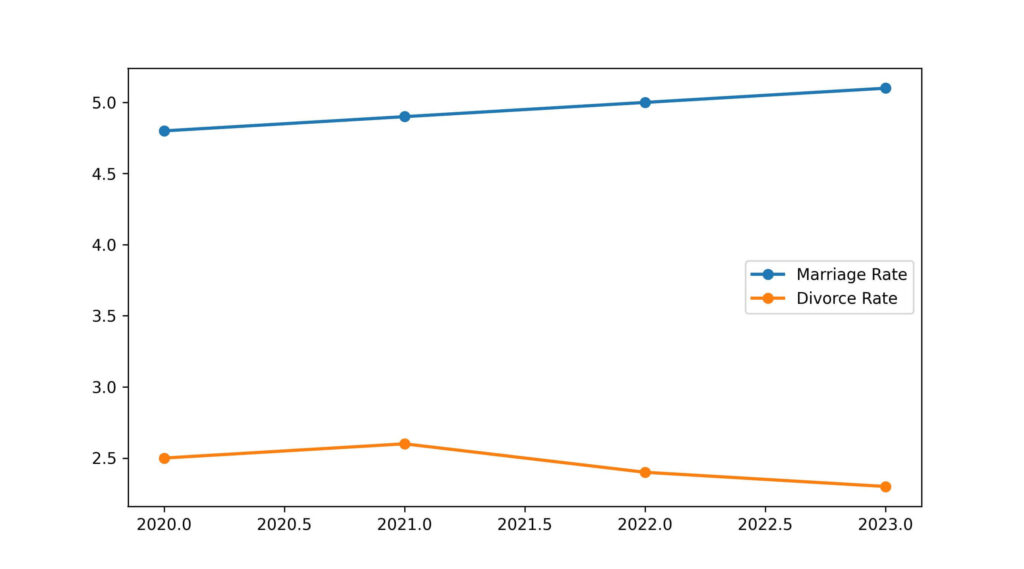
The median length of marriage in Pennsylvania is about 21.8 years. This includes both ongoing and ended marriages. So, Pennsylvanians really know how to stick it out – long enough to question if patience is a state virtue.
| Age Group (Years) | PA Divorce Occurrences (Number of Divorces, 2015) | U.S. Divorce Rate per 1,000 Married Women (2021) | Key PA/National Trend Observations |
|---|---|---|---|
| < 20 | 1,292 | 19.7 | Highest risk rate nationally. PA has the fewest occurrences, likely due to a very low number of marriages in this age group. |
| 20–24 | 22,033 (Combined 25–29 was highest) | 19.7 | Highest PA occurrence: many divorces involve at least one person in their late 20s or early 30s (25–29 and 30–34 were the top two groups). |
| 25–29 | 22,033 | 16.3 | |
| 30–34 | 13,084 | 14.9 | |
| 45–49 | 4,187 | 14.1 | |
| 50 and older | Not explicitly broken down | 10.3 (Refined 50+ rate) | Gray divorce trend: Divorce among adults 50+ has more than doubled nationally since 1990. |
| Overall Rate | 33,600 total divorces (2015) | 2.5 per 1,000 total population (U.S. Crude Rate, 2021) | Pennsylvania crude rate historically lower than national average (≈2.8 per 1,000 in 2021). |
Divorce Rate in Pennsylvania in 2025
- Low Crude Divorce Rate. Pennsylvania’s divorce rate is below the national average, around 2.2 divorces per 1,000 residents. Clearly, couples here are either really committed – or just very patient.
- “Hybrid” Grounds State
Pennsylvania allows three divorce pathways:- Mutual Consent (No-Fault): Both agree the marriage is irretrievably broken.
- One-Year Separation (No-Fault): One spouse asserts the marriage is broken after living apart for at least one year.
- Fault-Based: Divorce can be granted for specific faults such as adultery, cruel treatment, or desertion for a year.
- Mandatory 90-Day Waiting Period. Even for the quickest mutual-consent divorces, the court imposes a 90-day waiting period after filing – a mandatory “cooling-off” period.
- Reduced Separation Time. As of December 5, 2016, the required no-fault separation period dropped from two years to one year, speeding up divorces for non-consenting spouses.
- Equitable Distribution. Pennsylvania divides marital property fairly, not necessarily equally. Courts consider factors like the marriage length, age, health, and homemaker contributions.
- Fault Affects Alimony, Not Property. Marital misconduct may influence alimony amounts but generally doesn’t change property division.
- Relatively Short Residency Requirement. Only one spouse needs to have been a Pennsylvania resident for six months prior to filing for divorce.
Divorce Rate in Pennsylvania in 2024
- Below-Average Divorce Rate. Pennsylvania’s crude divorce rate is about 2.2 per 1,000 residents, slightly below the national average of 2.5.
- High Divorce Volume. Despite the lower rate, there were 27,210 divorces and annulments in 2024 – a reminder that “low rate” doesn’t mean “rare occurrence.”
- New Arbitration Law (Effective July 2024). The Family Law Arbitration Act (FLAA) allows couples to hire a private arbiter to make binding decisions on property, alimony, and child support outside court.
- No-Fault Still Dominates, But Fault Remains. Pennsylvania is a hybrid-grounds state. No-fault divorces (mutual consent or one-year separation) are most common, but fault-based grounds (e.g., adultery, cruel treatment, abandonment) are still recognized.
- Mandatory 90-Day Waiting Period. For mutual consent divorces, a 90-day waiting period applies after serving papers before finalizing the divorce.
- Mandatory One-Year Separation for Contested No-Fault. If one spouse disagrees, a one-year separation is required before the divorce can proceed.
- Financial Issues Must Be Resolved First. Equitable distribution, alimony, and other financial matters must be settled or waived before the divorce decree is granted.
- Ongoing Controversy Over Outdated Laws. In 2024, legislative debates (e.g., H.B. 2303) highlighted that Pennsylvania’s divorce laws are often seen as “antiquated,” leading to costly and lengthy proceedings, sometimes taking 2–3 years.
Divorce Rate in Pennsylvania in 2023
- Low Crude Divorce Rate. Pennsylvania’s divorce rate is around 2.4 per 1,000 residents, slightly below the national average of ~2.5.
- Three Paths to Divorce
The state offers three legal routes for an absolute divorce:- Mutual Consent: Both agree; shortest route with a 90-day waiting period.
- Irretrievable Breakdown (Unilateral): One spouse files; requires 1-year separation.
- Fault-Based: No waiting period but requires proof of fault (e.g., adultery, cruel treatment).
- Mandatory Waiting Periods
- Mutual Consent: 90-day waiting period from filing to final decree.
- Unilateral/Separation: One-year minimum separation; spouses may live under the same roof if living “separate lives.”
- Fault Still Matters. Pennsylvania recognizes six specific fault grounds. Proving fault bypasses mandatory waiting periods but often makes the divorce process longer due to litigation.
- Fault Can Affect Financial Outcomes. Property division follows Equitable Distribution, but marital misconduct may influence alimony or asset division if it causes substantial economic loss.
- High Volume of Cases. Despite the low rate, over 28,000 divorces and annulments occurred in 2023, showing that “low rate” doesn’t mean rare.