
Nebraska’s divorce rate is generally on the lower-to-middle end compared to other U.S. states. The crude divorce rate ranges from about 2.6 to 3.0 divorces per 1,000 residents. Provisional national data reports it at roughly 2.6 per 1,000. Overall, marriages in Nebraska appear moderately stable. So, in Nebraska, splitting up isn’t common – but don’t get too comfortable.
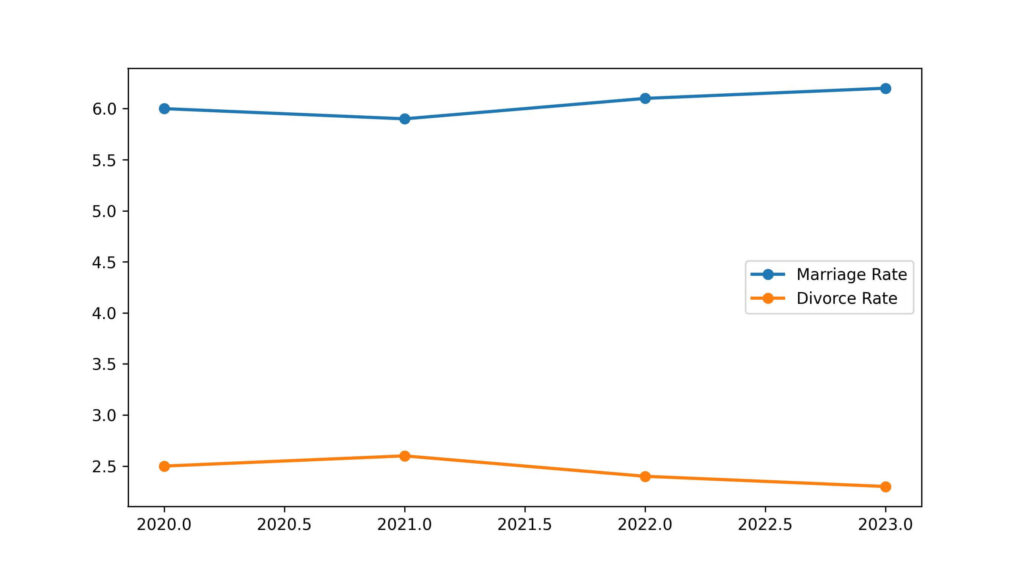
In Nebraska, the median length of marriage is about 18.6 years, including both ongoing and ended marriages. This reflects the typical duration couples stay together in the state. So, Nebraskans get a solid 18 years before considering whether to renew their “happily ever after” subscription.
| Age Group (Years) | U.S. Divorce Rate per 1,000 Married Women (2021) | Key National Trend Observations | Nebraska Overall Crude Divorce Rate (Recent Estimates) |
|---|---|---|---|
| 15-24 | 19.7 | Highest Rate. This group has the highest probability of divorce nationally. | 3.1 per 1,000 total population (2016 estimate) |
| 25-34 | 16.3 | High rate. Nebraska data suggests this age group is heavily involved in divorce filings (e.g., 45.8% involved someone 30-39 in 2010). | (Historically decreasing) |
| 35-44 | 14.9 | Marriages that last around the median duration (8 years) often place the individuals in this age bracket for their divorce. | |
| 45-54 | 14.1 | Rate is stable and lower than younger groups. | |
| 55-64 | 11.8 | Part of the “Gray Divorce” trend; the rate has significantly increased for this group since 1990. | |
| 65 and older | 5.5 | Lowest rate, but fastest-growing demographic for divorce since 1990. |
Divorce Rate in Nebraska in 2025
- Average Crude Divorce Rate. Nebraska’s divorce rate is around 2.6 per 1,000 residents, close to the national average, reflecting generally stable – but not extraordinary – marital patterns.
- Highly Ranked for Family Stability. Despite an average divorce rate, Nebraska ranks high in national Family Structure Indexes, indicating strong underlying family cohesion. So yes, families are strong – just not strong enough to beat the national average in divorces.
- Pure No-Fault Divorce. Nebraska only requires that a marriage is “irretrievably broken” to file for divorce. Proving fault such as adultery is unnecessary and not allowed.
- Mandatory 60-Day Waiting Period. After serving divorce papers, the court imposes a 60-day minimum waiting period before the final decree can be issued. Because nothing says efficiency like waiting two whole months to make it official.
- Long Residency Requirement. At least one spouse must have lived in Nebraska for one year with intent to make it their permanent home before filing.
- Equitable Distribution (Not 50/50). Marital property and debt are divided fairly, not necessarily equally, considering factors like contributions and marriage duration. Fair and equitable – because apparently math doesn’t always equal 50/50 in Nebraska courts.
- Re-Marriage Waiting Period. After divorce, there is a six-month mandatory wait before either party can legally remarry.
Divorce Rate in Nebraska in 2024
- Moderate Refined Divorce Rate. Nebraska’s refined divorce rate (per 1,000 married women) falls in the second national quartile (13.0–16.3), indicating moderate marital stability.
- High Marriage Rate. The state has one of the highest marriage rates in the U.S. (≈20.8 per 1,000 women). So many marriages, so many divorces… apparently math works differently here.
- Longest Residency Requirement. At least one spouse must reside in Nebraska for one year with intent to make it their permanent home before filing for divorce.
- Pure No-Fault State. Divorce requires only that the marriage is “irretrievably broken.” No proof of fault (adultery, cruelty, etc.) is needed. Because why make it complicated when you can just declare it over?
- Mandatory 60-Day Waiting Period. After filing and serving the divorce papers, there is a 60-day minimum waiting period before the final decree.
- Equitable Property Division (Not 50/50). Marital property is divided fairly, not necessarily equally, based on contributions, marriage length, and economic circumstances. Fair ≠ equal – so don’t expect your half to actually be half.
- Remarriage Waiting Period. After the final decree, neither party can legally remarry for six months.
- Mandatory Parenting Requirements, Parents with minor children must complete court-approved parenting classes and often attempt mediation before a trial.
Divorce Rate in Nebraska in 2023
- Low Crude Divorce Rate. Nebraska’s crude divorce rate is around 2.5 per 1,000 residents or lower, close to or below the national average, placing it in the lower-middle tier for marital instability.
- High Marriage Rate Contributes to Stability. With a marriage rate of about 20.8 per 1,000 women, Nebraska maintains low divorce rates despite many couples tying the knot. Apparently, lots of weddings magically prevent divorces… who knew?
- Pure No-Fault State. Divorce only requires that the marriage is “irretrievably broken.” Proving fault like adultery or cruelty is unnecessary.
- Mandatory 60-Day Waiting Period. After serving divorce papers, there’s a minimum 60-day wait before the final decree. Because nothing says patience like two months to make it official.
- Longer Remarriage Ban. After divorce, neither party can legally remarry for six months, longer than in many other states.
- Equitable Distribution Standard. Marital property is divided fairly, not necessarily 50/50, based on factors like contributions and marriage duration.
Fair sounds nice… until you realize your “half” might not actually be half. - Residency Requirement. At least one spouse must have lived in Nebraska for one year before filing, unless the marriage took place in the state and the petitioner has remained a resident.