
Missouri’s divorce rate is generally around the national average or slightly higher. The crude divorce rate ranges from about 2.6 to 3.7 divorces per 1,000 residents. A recent provisional figure reported it at 2.7 per 1,000. Overall, Missouri sits in the middle compared to other states. So, in Missouri, marriages are neither spectacularly doomed nor miraculously lasting – just comfortably average.
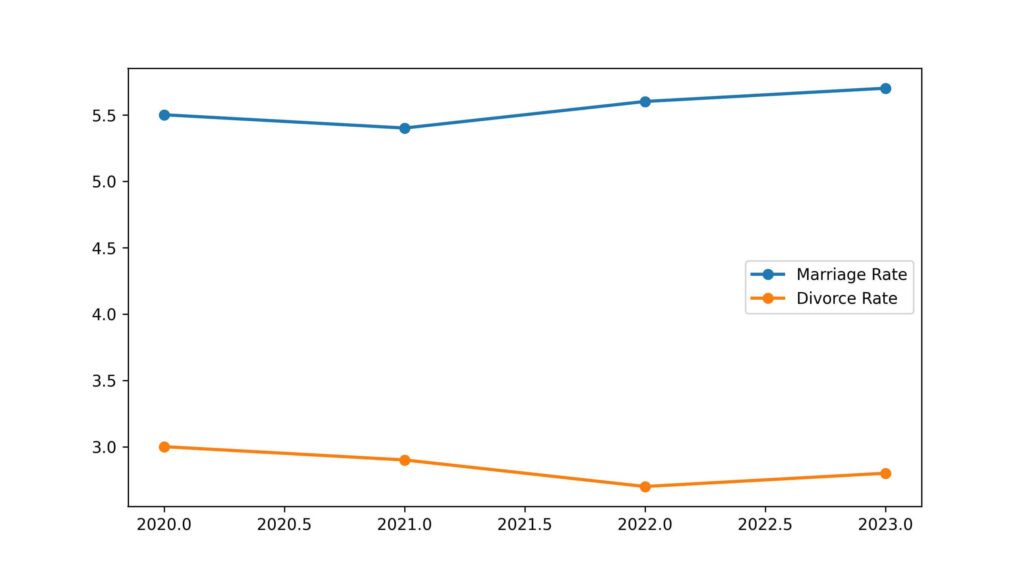
In Missouri, the median length of marriage is about 20 years, including both ongoing and ended marriages. This aligns closely with the national median for intact first marriages. So, Missouri couples can expect roughly two decades before the “til death do us part” memo kicks in.
| Age Group (Years) | U.S. Divorce Rate per 1,000 Married Women (2021) | Key National Trend Observations | Missouri Overall Crude Divorce Rate (Recent Estimates) |
|---|---|---|---|
| 15-24 | 19.7 | Highest Rate. This group has the highest probability of divorce nationally, correlated with younger marriage age. | 3.7 per 1,000 total population (2021 estimate) |
| 25-34 | 16.3 | High rate, though declining over the last few decades. | (Slightly higher than the national average of 2.9/1,000) |
| 35-44 | 14.9 | Marriages that last around the median duration (8 years) often place the individuals in this age bracket for their divorce. | |
| 45-54 | 14.1 | The rate has leveled off after being relatively stable. | |
| 55-64 | 11.8 | Part of the “Gray Divorce” trend; the rate has significantly increased for this group since 1990. | |
| 65 and older | 5.5 | The rate for this oldest group has nearly quadrupled since 1990, representing the fastest growth. |
Divorce Rate in Missouri in 2025
- Slightly Higher than Average Divorce Rate. Missouri’s crude divorce rate has historically been a bit above the national average. In 2021, it was roughly 3.7 per 1,000 residents, compared to the U.S. average of 2.4. The rate has been slowly declining since the 1990s.
- Hybrid Grounds for Divorce. Missouri is primarily a no-fault state, citing “irretrievably broken” marriages. However, if contested, historical fault or separation-based factors can be considered:
- Adultery or intolerable behaviorAbandonment for at least six monthsLiving separate and apart for 12 months (with consent) or 24 months (without consent)
- Minimal Mandatory Waiting Period. A 30-day waiting period applies after filing before a judge can finalize the divorce. “Separate and apart” living can technically be met under the same roof if spouses sleep separately and cease marital relations.
- Equitable Distribution (Not Equal). Missouri divides marital assets and debts fairly, not necessarily equally. Judges have broad discretion.Apparently “fair” is subjective and depends entirely on the judge’s mood.
- Fault Can Affect Financial Outcomes. While divorce itself doesn’t require fault, misconduct like excessive spending or gambling can reduce a spouse’s share of property or alimony.
- No Official Separation Required to File. Couples can file immediately; only the 30-day waiting period applies. Because patience is overrated, right?
- Low Residency Requirement. Only one spouse must have lived in Missouri for 90 days before filing, one of the shortest residency requirements in the Midwest.
Divorce Rate in Missouri in 2024
- Slightly Above National Average. Missouri’s crude divorce rate is estimated at 2.7 per 1,000 residents, slightly above the national average of 2.5.
- Long-Term Decline. Despite being above average, the divorce rate has steadily decreased since the 1990s, partly due to fewer young people marrying. So apparently waiting to get married magically makes divorces rarer – who knew?
- Pure No-Fault State. Missouri allows divorce solely on the grounds that the marriage is “irretrievably broken.” No proof of wrongdoing is needed, simplifying the process.
- Fault Irrelevant for Divorce Decree. Personal misconduct – adultery, cruelty, desertion – is irrelevant to ending the marriage. Because why bother with the messy details of who did what?
- Fault Can Affect Property Division. While fault doesn’t end the marriage, financial misconduct – hiding assets, wasting funds, or excessive spending—can lead to an unequal division of property.
- Equitable Distribution Standard. Property and debts are divided fairly, considering marriage length, contributions (including homemaking), and each spouse’s financial situation. “Fair” here is whatever the judge thinks is fair that day – good luck!
- No Mandatory Waiting Period. Missouri imposes no mandatory waiting period between filing and finalizing the divorce, allowing uncontested cases to proceed quickly.
- Residency Requirement. At least one spouse must have lived in Missouri for 90 days before filing the divorce petition.
Divorce Rate in Missouri in 2023
- Slightly Above National Average. Missouri’s crude divorce rate is roughly 2.6–2.7 per 1,000 residents, slightly above the national average of 2.5.
- Part of a Long-Term Decline. The divorce rate has dropped about 14% since 2011, following a broader national decline. Apparently, divorces just decided to take a little vacation.
- Mandatory 30-Day Waiting Period. Missouri requires a minimum 30-day waiting period from filing until the divorce can be finalized, one of the shortest in the U.S.
- “Same-Roof” Separation Allowed. Couples can meet the separation requirement while living in the same home, as long as they live apart in practice (e.g., separate bedrooms). Who knew marital separation could be a “sleep in your own bed” situation?
- No-Fault Divorce. The only legal ground required is that the marriage is “irretrievably broken.” No proof of misconduct is needed.
- Fault Can Influence Financial Outcomes. Judges may consider marital misconduct when dividing property or awarding alimony, making fault relevant to finances. Because money still has to punish someone for past drama, right?
- Equitable Distribution Standard. Property is divided fairly, not necessarily equally. Judges consider factors like marriage length, economic circumstances, and marital conduct.