
Iowa has a low divorce rate compared to the national average. Its crude divorce rate is about 1.9 to 2.0 divorces per 1,000 residents. This places the state well below the national average. Iowa is often ranked among the lowest-divorce states in the Midwest. Because apparently in Iowa, love lasts longer than a corn season.
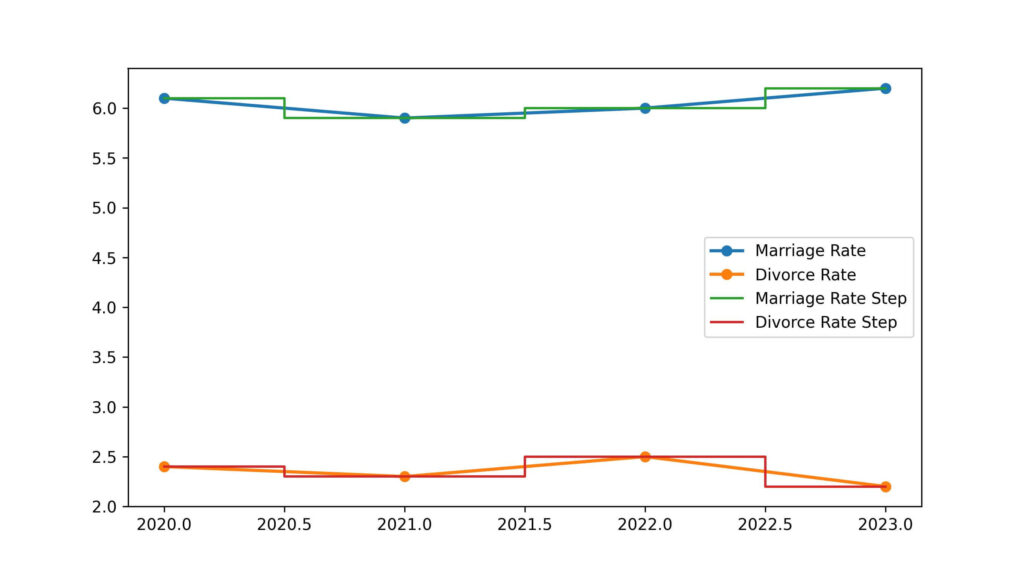
In Iowa, the median duration of all marriages, including intact and ended, is about 22 years, one of the longest in the U.S. This reflects a stable and enduring marriage trend in the state. Because apparently in Iowa, couples stick together long enough to outlast two decades of cornfields and county fairs.
| Age Group | U.S. Divorce Rate (Per 1,000 Married Women) | Key Trend & Context in Iowa |
|---|---|---|
| Ages 15–24 | 17.8 | Highest Risk: Reflects the high risk associated with marrying young. |
| Ages 25–34 | 17.2 | High Rate: Continues to show a high rate of marital dissolution in early adulthood. |
| Ages 35–44 | 14.5 | Above Average: The rate begins to decline as marriages become more established and stable. |
| Ages 45–54 | 13.5 | Moderate Rate: Represents divorces in middle age. |
| Ages 55–64 | 11.4 | Increasing Rate (“Gray Divorce”): The rate for this group has risen nationally, though Iowa’s overall lower rate may mitigate this. |
| Ages 65 and Older | 5.6 | Lowest Rate: The lowest risk group for divorce, representing marriages that have endured long-term. |
Divorce Rate in Iowa in 2025
- Low Crude Divorce Rate. Iowa reports a low crude divorce rate of about 1.9 per 1,000 residents, ranking among the states with the lowest divorce rates nationwide.
- Pure No-Fault State. Divorce requires only a “breakdown of the marriage relationship”, with no consideration of fault. Because clearly, blame has nothing to do with anything here.
- Mandatory 90-Day Waiting Period. Couples must wait at least 90 days after filing and serving the petition before a final decree can be granted.
- 1-Year Residency Requirement. At least one spouse must have lived in Iowa for a year (unless the respondent is an Iowa resident). Patience is a virtue – especially if you want a divorce in Iowa.
- Fault Irrelevant to Property Division. Marital misconduct does not affect property division or spousal support, reinforcing the no-fault principle.
- Equitable Distribution of All Property. Iowa courts divide all property fairly, including pre-marriage assets, with exceptions only for gifts and inheritances. Because dividing decades of accumulated stuff is obviously fun for everyone involved.
- Mandatory Parent Education. Parents with minor children must complete a “Children in the Middle” course within 45 days of the case starting.
- Conciliation Procedures. Courts may require mediation or counseling for up to 60 days before finalizing the divorce to encourage reconciliation.
Divorce Rate in Iowa in 2024
- Low Crude Divorce Rate. Iowa’s crude divorce rate is about 1.9–2.0 per 1,000 residents, well below the national average of ~2.5.
- Low Refined Divorce Rate. Divorces per 1,000 married women in Iowa are also below the national average. Apparently, Iowans just like sticking it out – how boringly responsible.
- Later Marriage Age Helps. The median age at first marriage in Iowa has risen, contributing to more stable, longer-lasting marriages.
- Mandatory 90-Day Waiting Period. Courts require a minimum 90-day wait after serving divorce papers before granting a final decree. Because nothing says efficiency like a three-month waiting game.
- Pure No-Fault Divorce. Divorce only requires that the marriage has “broken down,” with no blame assigned to either spouse.
- Fault Irrelevant to Property and Alimony. Courts divide property and award spousal support based purely on financial factors, contributions, and needs. Yes, decades of drama are conveniently ignored – lucky for everyone.
- Residency Rules. Generally, the filing spouse must have lived in Iowa for at least one year, but this is waived if the respondent is an Iowa resident.
- Spousal Support Types
Iowa recognizes three types of alimony:- Traditional – long-term/permanent
- Rehabilitative – short-term for education or training
- Reimbursement – repayment for financial support during education
Divorce Rate in Iowa in 2023
- Low Crude Divorce Rate. Iowa’s crude divorce rate is about 1.9 per 1,000 residents, well below the national average of ~2.4, placing it among the states with lower divorce rates.
- Low Refined Divorce Rate. Divorces per 1,000 married women in Iowa were approximately 6.1, below the national average of ~7.1. Iowans must really enjoy commitment – or they’re just stubborn.
- Pure No-Fault State. Divorce only requires a “breakdown of the marital relationship”, with no need to assign blame.
- Mandatory 90-Day Waiting Period. Courts enforce a minimum 90-day wait after serving papers before granting a final decree. Because nothing says patience like three months of legal limbo.
- Equitable Distribution of Property. All property (except gifts and inheritances) is divided fairly, though not necessarily equally, according to the court’s discretion.
- Marital Fault Irrelevant to Property and Alimony. Judges cannot consider adultery, cruelty, or other faults when dividing property or awarding spousal support. Decades of drama? Totally irrelevant – how convenient.
- Residency Requirement. The filing spouse must have lived in Iowa for at least one year, unless the respondent is an Iowa resident and personally served, in which case the rule is waived.
- Mandatory Parent Education. When minor children are involved, courts may require conciliation procedures and a parenting class, often titled “Children in the Middle.”