
Illinois has one of the lowest divorce rates in the United States. Its crude divorce rate is typically 1.2 to 2.2 divorces per 1,000 residents, well below the national average. This consistently places the state among the lowest-ranking states for divorce. Illinois often ranks within the top five states with the fewest divorces. Because nothing says “true love” like surviving Chicago winters together without filing for divorce.
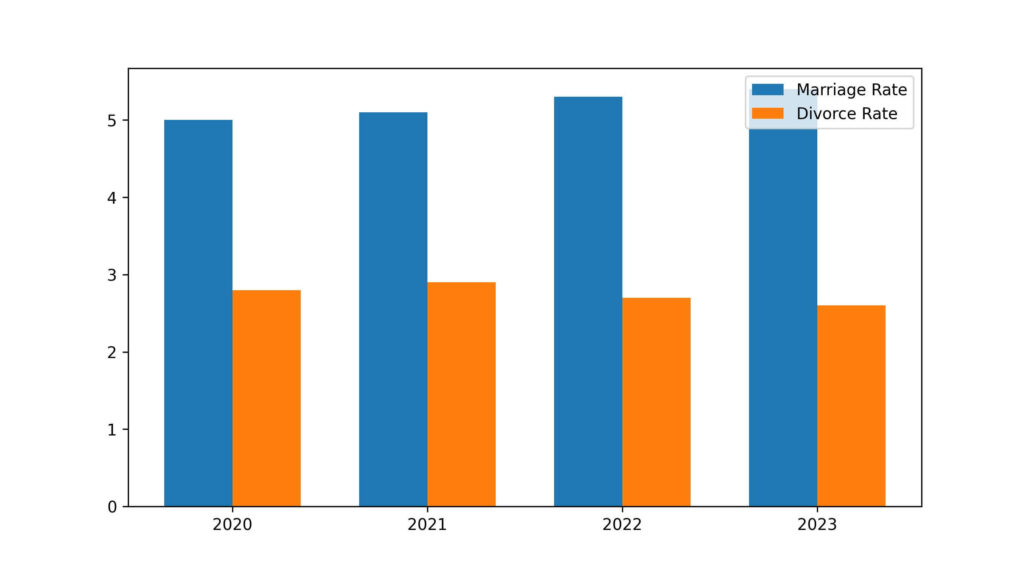
In Illinois, the average length of all marriages, including intact and ended, is about 20 years, slightly above the national median. This reflects a relatively stable marriage duration compared to other states. Because apparently in Illinois, couples stick together long enough to see two decades of deep-dish pizza and snowstorms.
| Age Metric / Group | Illinois Trend & Context | Key Insight |
|---|---|---|
| Ages 25–39 (Spouses) | Majority of Divorces | Nationally, this age group accounts for about 60% of all divorces. This trend is generally mirrored in Illinois for dissolution in the early and middle years of marriage. |
| Ages Under 25 at Marriage | Highest Risk Factor | Marrying before age 25 carries the highest statistical risk of divorce due to factors like immaturity and financial instability. |
| Ages 25–32 at Marriage | Highest Success Rate | Couples in Illinois who marry in this age range statistically have the highest marriage success rates, which contributes to the state’s low overall divorce rate. |
| Median Age at First Divorce (National) | ~30 years old | While Illinois-specific data is limited, the national median age for a first divorce falls in this range, suggesting a high concentration of divorces occur among young adults. |
| Ages 50 and Older | “Gray Divorce” Trend | The divorce rate for older couples has increased nationally. Illinois is seeing this increase, though the overall risk remains lower than for younger groups. |
Divorce Rate in Illinois in 2025
- Among the Lowest Divorce Rates Nationally. Illinois consistently ranks among the states with the lowest crude divorce rates, around 1.1–1.3 divorces per 1,000 residents – well below the national average.
- Why the Rate is Low. Factors include higher household incomes, higher education levels, and later-age marriages. So basically, money, degrees, and growing up a bit actually help marriages survive – who knew?
- Pure No-Fault Divorce (Since 2016). Illinois eliminated all fault-based grounds; only “irreconcilable differences” matter. Adultery, cruelty, or abandonment no longer affect the divorce decree.
- Fault Doesn’t Affect Property or Alimony. Judges generally cannot consider marital misconduct when dividing property or setting alimony, unless one spouse wasted marital assets. Cheating may break hearts, but apparently it can’t break the bank – lucky for some!
- Six-Month Separation Rule. If contested, living separate and apart for six continuous months proves irreconcilable differences – even under the same roof if marital relations have ceased.
- Equitable Distribution. Property and debts are divided fairly by the court, often nearly 50/50. Fair means fair – or just enough to argue over who keeps the Netflix account.
- No Mandatory Waiting Period. After meeting the 90-day residency requirement, there’s no cooling-off period; uncontested divorces can be finalized quickly.
Divorce Rate in Illinois in 2024
- Among the Lowest Divorce Rates. Illinois consistently ranks among the states with the lowest divorce rates. In 2024, the crude divorce rate was approximately 1.3–1.6 per 1,000 residents, well below the national average of ~2.5.
- High Income and Education Factors. Higher median household incomes and a well-educated population contribute to marital stability. So apparently, money and degrees are marriage insurance – who would’ve guessed?
- Pure No-Fault Divorce. Since 2016, Illinois allows only “irreconcilable differences” as grounds for divorce. No need to prove adultery or other faults.
- Short Separation Requirement. Only six months of separation are required to establish an irrebuttable presumption that the marriage is broken. Separation can occur even in the same home if marital relations have ended. Six months of awkward breakfasts alone, and voilà – divorce granted!
- Equitable Distribution of Property. Marital assets are divided fairly according to the court’s judgment, though not necessarily 50/50.
- Alimony Formula. Spousal maintenance is often calculated as 30% of the paying spouse’s gross income minus 20% of the receiving spouse’s income, typically tied to the marriage’s duration. Math skills suddenly become the key to heartbreak.
- Focus on Parental Responsibilities. Illinois now uses “Parental Responsibilities” and “Parenting Time” instead of “custody” and “visitation,” prioritizing the child’s best interests.
Divorce Rate in Illinois in 2023
- Among the Lowest Divorce Rates. Illinois consistently ranks among the states with the lowest divorce rates. In 2023, the crude divorce rate was about 1.2–1.6 per 1,000 residents, well below the national average of ~2.4.
- Low Percentage of Divorced Population. Only around 6.6% of marriages in Illinois end in divorce, compared to roughly 16% nationwide. Apparently, most Illinois couples are just really good at staying married – or at hiding the paperwork.
- Cost May Be a Factor. Illinois is among the ten most expensive states for obtaining a divorce, which may discourage financially stressed couples from filing.
- Pure No-Fault State. Only “irreconcilable differences” are required for divorce; no need to prove misconduct or fault. Cheating, lying, or screaming matches – none of that matters, just admit it’s over!
- Implicit Six-Month Separation Rule. The court presumes irreconcilable differences if spouses have lived apart for six months, effectively creating a standard separation period.
- Equitable Distribution Standard. Marital property and debts are divided fairly, though not necessarily 50/50. Fair division is subjective – because who doesn’t love a little court-approved math debate?
- Modern Family Law Terminology. “Custody” is now “allocation of parental responsibilities” and “visitation” is “parenting time.” Parents must attend a mandatory parenting education program.