
Georgia’s divorce rate is considered low compared to most states. Its crude divorce rate is about 2.1 to 2.2 divorces per 1,000 residents, according to recent provisional data. This level places Georgia below the national average. Overall, the state consistently ranks among the lower-divorce states in the U.S. Because nothing says everlasting love like Atlanta traffic testing your patience daily.
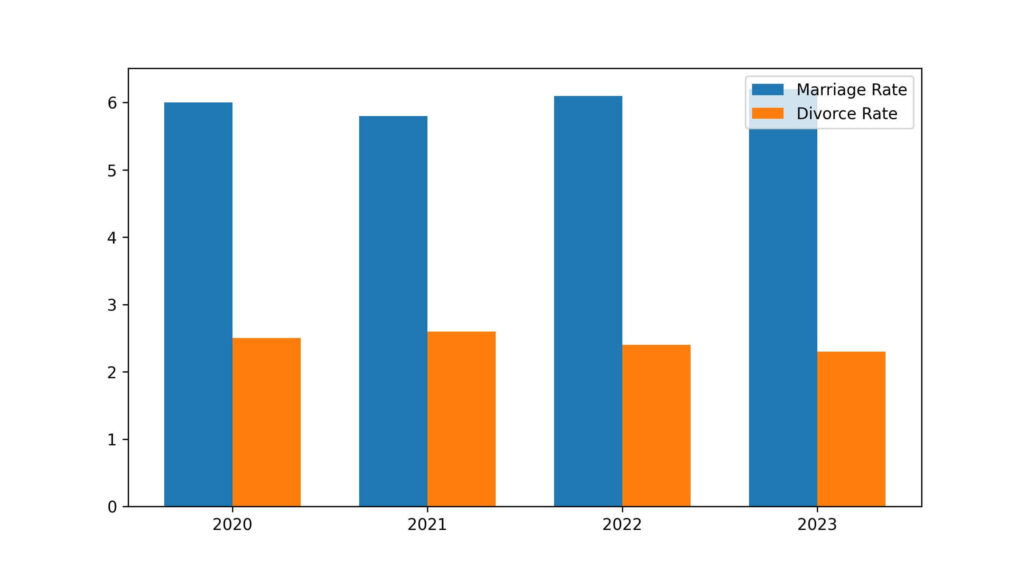
In Georgia, the median length of marriage is about 18.8 years, slightly shorter than the national average of 20–21 years. This includes both intact marriages and those that ended in divorce. Because apparently in Georgia, sweet tea and southern charm can’t quite make a marriage last two decades.
| Age Group (Spouses) | Georgia Trend & Context | Key Insight |
|---|---|---|
| Ages 30–34 (Women) | Highest Number of Divorces | This specific age range for women has recently shown the highest number of divorces compared to any other age or gender group in Georgia. |
| Ages 25–39 (Spouses) | Majority of Divorces | This broad age range accounts for the majority of divorced males and females, reflecting dissolution in the early and middle years of marriage (often years 5–15). |
| Ages Under 34 (Women) | More Likely to Initiate Divorce | Women in Georgia are statistically more likely to initiate divorce proceedings than men when they are younger than 34. |
| Ages 50 and Older | Rising Rate (“Gray Divorce”) | The divorce rate for this age group has doubled nationally since 1990. In Georgia, divorces after 20 years of marriage are nearly as common as those in the 10–14 year range. |
| Ages 60 and Older | Low but Significant Number | In recent years, the number of divorced men and women over the age of 60 was 10% higher than those in the 20–24 age range, indicating a significant volume of late-life divorces. |
Divorce Rate in Georgia in 2025
- Moderate Divorce Rate. Georgia’s crude divorce rate sits near or slightly below the national average, though online search data shows Georgians think about divorce far more often than they actually file.
- Thirteen Grounds for Divorce. Georgia uses a mixed system with both fault and no-fault options, including 13 total grounds (12 fault-based). Because nothing says “romance” like having a full buffet of legal reasons to call it quits.
- No-Fault Option. The most common ground is the simple no-fault claim that the marriage is “irretrievably broken.”
- Fault Grounds. Fault-based grounds include adultery, desertion, cruelty, and habitual intoxication. Basically, if it’s dramatic enough for a soap opera, it probably counts.
- Impact of Fault on Alimony. Proving adultery or desertion can block the offending spouse from receiving alimony, making fault a powerful tool in negotiations.
- Equitable Distribution. Georgia divides marital property based on fairness rather than strict 50/50 rules. Translation: “fair” means whatever the court says it means today.
- Fast Uncontested Divorces. An uncontested divorce can be finalized in as little as 31 days – one of the quickest minimum waiting periods in the nation.
- Residency Requirement. At least one spouse must have lived in Georgia for six months prior to filing.
- Demographic Differences. Divorce trends vary widely by education level and across racial and ethnic groups in the state.
Divorce Rate in Georgia in 2024
- Low Crude Divorce Rate. Georgia’s crude divorce rate is around 2.1 per 1,000 residents, placing it among the lowest states in the U.S., well below the national average of ~2.5 per 1,000.
- Low Refined Divorce Rate. The state also ranks in the bottom quartile for refined divorce rate (per 1,000 married women), suggesting longer-lasting marriages. Apparently, Georgians are really committed… or just really good at avoiding paperwork.
- Education as a Protective Factor. Higher educational attainment correlates with lower divorce rates. Individuals with a bachelor’s degree or higher are much less likely to divorce than those with only a high school diploma.
- Hybrid Grounds for Divorce. Georgia allows both no-fault and fault-based divorces, recognizing 13 fault grounds like adultery, cruel treatment, and desertion. Because why settle for just one reason when you can have a dozen?
- No-Fault Ground. The most commonly used ground is that the marriage is “irretrievably broken.”
- Fault Matters for Alimony. Proving fault (e.g., adultery or desertion) can block a spouse from receiving alimony, making fault a key financial strategy. Nothing motivates honesty like the threat of losing spousal support.
- Child Support Law Update (July 2024). New amendments include updated basic support tables and a parenting time adjustment formula (effective 2026).
- Residency Requirement. At least one spouse must have been a Georgia resident for six months before filing for divorce.
Divorce Rate in Georgia in 2023
- Below-Average Crude Divorce Rate. Georgia’s crude divorce rate was approximately 2.2 per 1,000 residents, slightly below the national average of 2.4.
- Hybrid Grounds State (13 Grounds). Georgia allows both no-fault and fault-based divorces, including 12 specific fault grounds like adultery, cruel treatment, and desertion. Because why settle for one reason when you can have a dozen?
- Mandatory 30-Day Waiting Period. The state imposes a minimum 30-day waiting period from filing to final decree – one of the shortest in the U.S.
- Fault Bars Alimony. Spouses proven to have caused the separation through adultery or willful desertion are ineligible for alimony, and courts must consider misconduct in alimony decisions. Nothing like a courtroom drama to motivate good behavior.
- “Separation” Allows Same-Roof Living. Couples can file for divorce while living under the same roof, as long as they are legally “separated” (ceased sexual relations and no longer live as husband and wife).
- Equitable Distribution Standard. Marital property is divided fairly according to the court’s discretion, factoring in financial contributions and homemaking, rather than a strict 50/50 split. “Fair” here means whatever the judge feels like today.
- Later Age of Marriage. The median age at first marriage is 30.6 for men and 28.4 for women, which contributes to slightly greater marital stability.