
Florida’s divorce rate is considered high compared to most states. Its crude divorce rate is usually 3.0 to 3.4 divorces per 1,000 residents, well above the national average. This consistently places Florida among the higher-divorce states in the country. Some reports even rank it within the top ten states for divorce rates. But hey, nothing keeps love alive like humidity, traffic, and alligators watching your relationship fall apart.
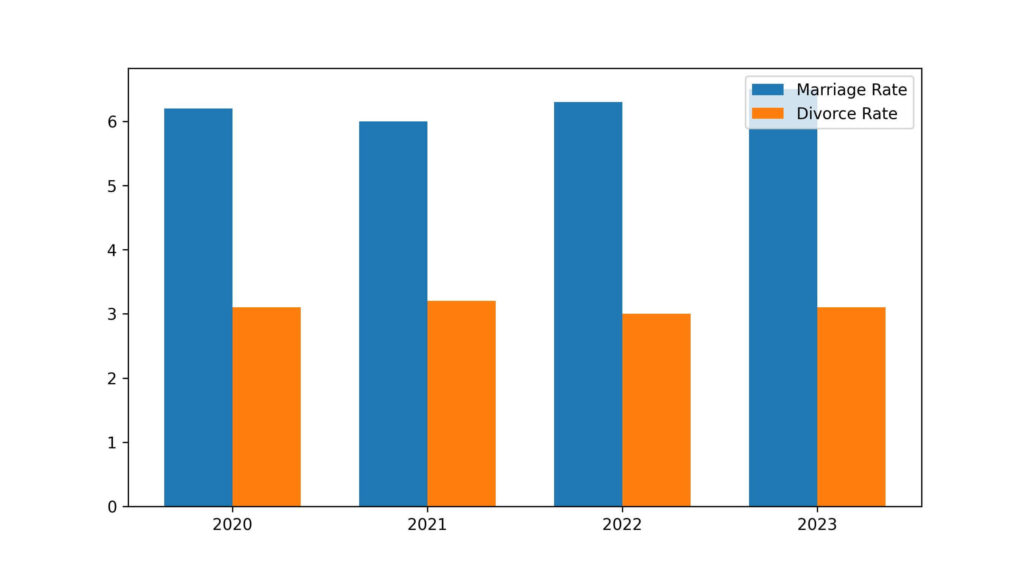
In Florida, marriages that end in divorce last on average about 8 to 8.2 years, making this the most relevant measure for dissolved unions. Some sources report longer averages for all first marriages, but the shorter figure reflects actual divorces. Because apparently in Florida, even sunshine and sandy beaches can’t keep a marriage past eight years.
| Age Group (Married Women) | U.S. Divorce Rate (Per 1,000) | Key Trend & Context in Florida |
|---|---|---|
| Ages 15–24 | 17.8 | Highest Risk: Marrying at a very young age carries the highest statistical risk of divorce. |
| Ages 25–34 | 17.2 | High Rate: This age range represents a high volume of divorces, often occurring around the 7 to 10-year mark of marriage. |
| Ages 35–44 | 14.5 | Above Average: Rate begins to decline, representing divorces in mid-life (median age for first divorce in Florida is ∼40 for women). |
| Ages 45–54 | 13.5 | Moderate Rate: Continues to decline, but the rate of “Gray Divorce” begins to accelerate here. |
| Ages 55–64 | 11.4 | Elevated “Gray Divorce”: This rate has doubled nationally since 1990 and is particularly pronounced in Florida due to its large senior population. |
| Ages 65 and Older | 5.6 | Increasing Rate: The divorce rate in this group has nearly tripled nationally since 1990, driven by longer life expectancy and remarriages, a trend magnified in Florida’s retirement communities. |
Divorce Rate in Florida in 2025
- High National Ranking. Florida consistently ranks among the top 10 states for crude divorce rates, typically landing between 5th and 8th. Its rate of about 3.4 divorces per 1,000 residents remains well above the national average.
- Pure No-Fault Divorce System. Florida requires only one ground for divorce: the marriage is “irretrievably broken.” No proof of wrongdoing – such as adultery or abuse – is needed to file or finalize the divorce.
- Fault Still Matters for Money. Although fault doesn’t affect the ability to divorce, judges may consider marital misconduct (like wasting marital funds on gambling or affairs) when deciding property division and sometimes alimony.
- Equitable Distribution State. Florida divides marital property according to what is fair, not automatically 50/50, although courts start with the presumption of an equal split before adjusting for specific circumstances.
- Six-Month Residency Requirement. At least one spouse must have lived in Florida for six months prior to filing for divorce.
- Higher Risk in Second and Third Marriages. With its large retiree population and high number of remarriages, Florida sees elevated divorce risks: roughly 60–67% for second marriages and up to 73% for third or later marriages.
- A Hub for Gray Divorce. Florida is a major center for divorce among adults over 50, often involving complex financial issues such as pensions, Social Security, and retirement accounts.
- Simplified Divorce Option. Florida offers a Simplified Dissolution of Marriage for couples with no minor children and a full agreement on assets and debts, allowing for a faster, more streamlined process.
Divorce Rate in Florida in 2024
- High Crude Divorce Rate. In 2024, Florida’s crude divorce rate was about 3.4 per 1,000 residents, placing it among the top 10 states for divorce and well above the national average of roughly 2.5.
- Extreme Geographic Variation. Divorce rates differ sharply across the state: some small cities, like Live Oak, reported 10–11% divorce rates in 2024, while more urban or affluent areas showed much lower levels.
- Significant “Gray Divorce” Trend. With its large retiree population, Florida sees a high share of divorces among adults 50+, including many long-term marriages of 20 years or more.
- Pure No-Fault Divorce System. Florida requires only one ground for divorce – the marriage is “irretrievably broken.” No evidence of fault, such as adultery or abuse, is needed.
- New Alimony Law (Effective July 1, 2024). Permanent alimony was eliminated for new cases, shifting to durational alimony with set limits based on marriage length.
- Updated Equitable Distribution Rules (2024). Florida still uses equitable distribution, but 2024 reforms clarified how to value complex assets (like closely held businesses) and strengthened protections for inherited property.
- Mandatory Financial Disclosure. Both spouses must provide full financial disclosures – including a financial affidavit – within 45 days of the petition being served.
- Six-Month Residency Requirement. At least one spouse must have lived in Florida for six months before filing for divorce.
Divorce Rate in Florida in 2023
- High Crude Divorce Rate. Florida’s 2023 crude divorce rate was about 3.4–3.6 per 1,000 residents, consistently placing it in the top 10 nationwide and well above the national average of roughly 2.4.
- Strong “Gray Divorce” Influence. Divorce among adults over 50 has surged, doubling over the past 30 years. Many cases involve second or third marriages, contributing significantly to the state’s high divorce volume.
- Women Initiate Most Divorces. In 2023, women filed nearly 75% of divorce actions in Florida, mirroring a strong national pattern.
- Pure No-Fault System (With One Narrow Exception). Florida allows divorce solely on the basis that the marriage is “irretrievably broken.” The only exception is when one spouse is proven to be mentally incapacitated for three years or more.
- Short 20-Day Waiting Period. Florida imposes a minimal 20-day waiting period between filing the petition and the earliest date a court can finalize the divorce.
- Financial Misconduct Still Matters. While fault isn’t required, judges can consider adultery or other financial misconduct – such as wasting marital funds – when deciding alimony or dividing assets.
- Six-Month Residency Requirement. At least one spouse must have lived in Florida for six months before filing for divorce.
- Simplified Divorce Option. Couples with no minor children, no pregnancy, full agreement on all issues, and no alimony requests can use Florida’s Simplified Dissolution of Marriage, a faster and less complicated process.