
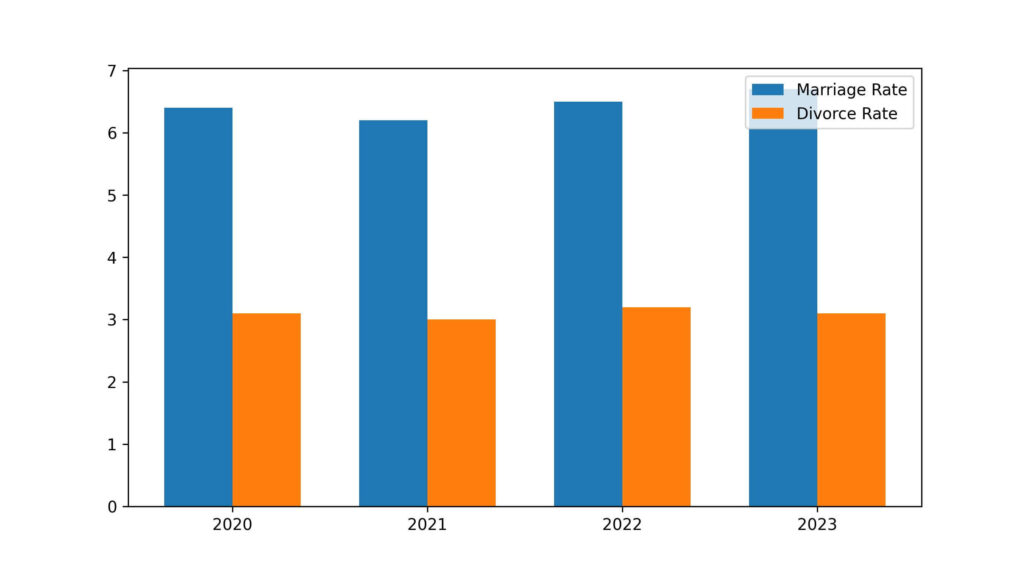
Utah’s divorce rate is higher than the national average when considering the total population. The crude divorce rate is typically between 3.3 and 3.5 divorces per 1,000 residents. This places the state in the upper tier nationally, often ranking 11th to 15th highest. The rate is influenced by Utah’s high marriage rate, which increases the pool of potential divorces. Clearly, Utahns like to marry a lot – and sometimes change their minds just as quickly.
The median length of marriage in Utah is between 20.9 and 23.6 years, depending on the study. This includes both ongoing and ended marriages. So, Utah couples really take their time – long enough to master the art of compromise or at least memorize each other’s quirks.
| Age Group (Years) | Highest Divorce Incidence (Based on Utah County Data) | U.S. Divorce Rate per 1,000 Married Women (2021) | Key Utah/National Trend Observations |
|---|---|---|---|
| 20–24 | Highest % Divorced for Women in one county study (23.2%) | 19.7 | High risk nationally. Utah’s trend of early marriage often leads to a higher divorce rate in this young age group. |
| 25–34 | High incidence for both men (30–34) and women (25–39 combined) | 16.3 | This age group includes the typical duration for first marriages that end in divorce (often less than 10 years). |
| 35–39 | Highest % Divorced for Men in one county study (31.7%) | 14.9 | The median age of divorce nationally falls in this range (around 40 for women and 42 for men). |
| 40–44 | Highest % Divorced for Women overall in one study (45.3%) | 14.1 | |
| 55 and older | Not explicitly broken down | 10.3 (Refined 50+ rate) | Gray Divorce Trend: Divorce among adults 50+ has more than doubled nationally since 1990. |
| Overall Crude Rate | 3.3 per 1,000 total population (2021) | 2.5 per 1,000 total population (U.S. Crude Rate, 2021) | Utah’s crude rate is higher than the national average but has been steadily declining. |
Divorce Rate in Utah in 2025
- Low Crude Divorce Rate. Utah consistently reports one of the lowest crude divorce rates in the U.S., around 2.0–2.2 per 1,000 residents – well below the national average.
- High Refined Divorce Rate Paradox. Despite fewer divorces per capita, the refined divorce rate (divorces per 1,000 married women) is often above the national average due to Utah’s high marriage rate. So, fewer divorces happen, but if you do get married here, better buckle up.
- Mormon Cultural Influence. LDS culture encourages early marriage and high fertility, which statistically increases the risk of divorce for younger couples, contributing to the high refined rate.
- Mandatory Waiting Period. There’s a 90-day waiting period after filing before a divorce can be finalized, giving couples time to reconsider or finalize agreements. Nothing like a three-month “time-out” to really test your patience.
- Mandatory Education and Counseling. Couples with minor children must complete divorce orientation and education classes. Courts may also require conciliation counseling to explore reconciliation.
- Fault Can Affect Property and Alimony. Utah recognizes fault in divorce. Adultery, abuse, or other misconduct can influence property division and alimony, even though most cases use no-fault “irreconcilable differences.” Sure, it’s mostly no-fault – but your bad behavior could still haunt your wallet.
- Equitable Distribution of Property. Marital property is divided fairly, not necessarily equally. Courts consider factors like the parent’s ability to provide a stable home for children.
Divorce Rate in Utah in 2024
- Above-Average Crude Divorce Rate. Utah’s crude divorce rate is around 3.3 per 1,000 residents (2021 data), above the national average of ~2.5.
- High Marriage Rate Factor. Despite higher divorces, Utah also has one of the highest marriage rates in the U.S., meaning more couples enter the risky game in the first place. Apparently, everyone wants a slice of the Utah wedding cake… even if it crumbles fast.
- Major Alimony Amendments (Effective Sept 2024). New laws overhaul how courts calculate alimony, including standards of living and restrictions on reducing support for the recipient spouse.
- Equalizing Income Provisions. Courts may adjust alimony to account for income disparities, especially when one spouse reduced their career to care for children. So now, good luck trying to “sacrifice” for the kids without the court noticing.
- Pure No-Fault is Primary. The fastest and simplest divorces still cite “irreconcilable differences.”
- Fault Still Exists and Affects Alimony. Utah recognizes fault (adultery, abuse, etc.), which judges can factor into alimony decisions. Your messy mistakes won’t go unnoticed – your wallet might feel it.
- Short Mandatory Waiting Period. A 30-day minimum wait is required from filing to final decree, one of the shortest in the U.S., and can be waived only in extraordinary circumstances.
- High County Variation. Divorce rates vary widely: Grand County has ~21% divorced, while Morgan County is much lower at ~5.9%.
- Mandatory Child-Related Education. Parents with minor children must complete Divorce Orientation and Divorce Education classes before finalizing the divorce.
Divorce Rate in Utah in 2023
- Marital Stability Paradox. Utah had the highest percentage of married adults in 2023 (54.9%). While many divorces occur due to the sheer number of marriages, the refined divorce rate (~13.3 per 1,000 married women) aligns with the national average.
- Decade-Long Decline in Divorce Rate. Utah’s divorce rate dropped from 21.6 in 2010 to 13.3 in 2023, slightly outpacing the national decline. Fewer divorces—but don’t get too comfortable, there’s still plenty of paperwork.
- Mandatory 90-Day Waiting Period (General Rule). A 90-day minimum wait applies from filing to final decree, giving couples time to reconsider or finalize agreements.
- Shortest Waiting Period (Waiver). Judges can waive the 90-day period in rare, compelling cases, with a legal minimum of 30 days. Because nothing says “hurry up” like a judge saying, “Fine, 30 days will do.”
- High Percentage of Divorces Involve Children. About 60% of divorces in 2023 involved families with minor children.
- Mandatory Parent Classes. Parents with minors must complete Divorce Orientation and Divorce Education classes before the final decree. Congratulations, your divorce now comes with homework.
- Dual-Grounds State (Fault and No-Fault). No-fault (“Irreconcilable Differences”) is most common, but Utah also recognizes eight fault-based grounds like adultery or extreme cruelty.
- Fault Can Affect Financial Outcomes. Judges may consider fault when dividing property or awarding alimony, especially if misconduct caused economic, physical, or emotional harm.