
Oregon’s divorce rate generally falls in the upper-middle range among U.S. states. The crude divorce rate is typically between 2.8 and 3.4 divorces per 1,000 residents. Recent provisional data places it at about 2.8 per 1,000. This ranks Oregon roughly 14th highest in the nation. Seems like Oregonians are committed – just not too committed.
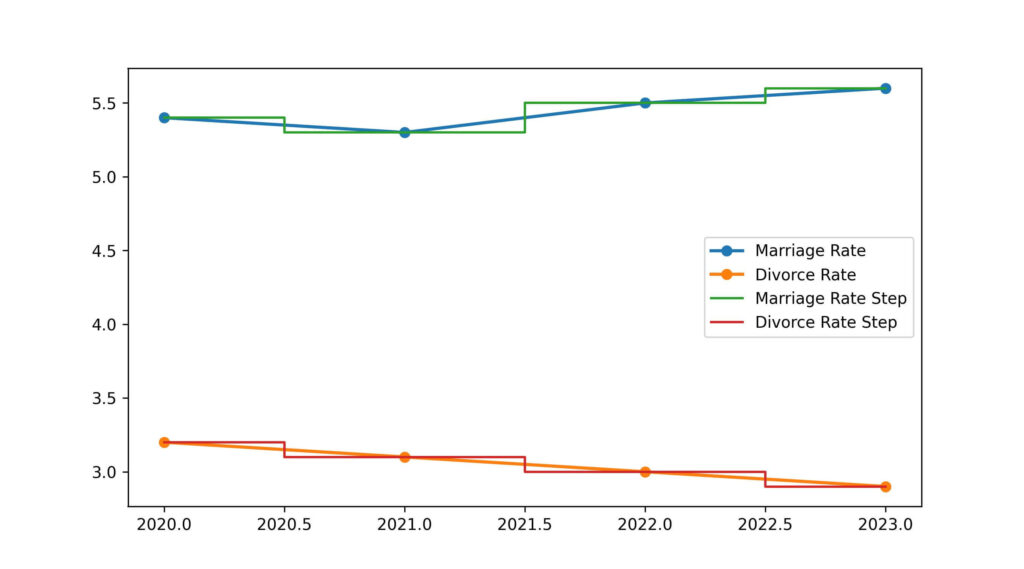
The median length of marriage in Oregon is about 18.4 years. This includes both ongoing marriages and those that have ended in divorce. So, Oregonians fall a bit short of the national average – long enough to figure out each other’s quirks, but not long enough to perfect patience.
| Age Group (Years) | U.S. Divorce Rate per 1,000 Married Women (2021) | Key Oregon/National Trend Observations | Oregon Overall Divorce Rate (Recent Estimates) |
|---|---|---|---|
| 15–24 | 19.7 | Highest rate — divorce is most likely for those who marry young nationally. | 2.8 per 1,000 total population (Crude Rate, 2021) |
| 25–34 | 16.3 | High rate, though rates are dropping for younger generations due to later marriage. | 12.5% of adults aged 15+ have been divorced (higher than national average of 10.5%) |
| 35–44 | 14.9 | The median duration of a first marriage that ends in divorce (8 years) often places individuals in this age bracket. | |
| 45–54 | 14.1 | Stable rate, slightly lower than younger groups. | |
| 55–64 | 11.8 | Part of the “Gray Divorce” trend; the rate for this group has more than doubled nationally since 1990. | Higher Median Age: Oregon’s median age (40.5) is higher than the national average (39), which often correlates with higher Gray Divorce figures. |
| 65 and older | 5.5 | Lowest rate, but fastest-growing demographic for divorce since 1990. |
Divorce Rate in Oregon in 2025
- Average to Slightly Above-Average Rate. Oregon’s crude divorce rate is slightly above the national average, around 2.8 per 1,000 residents, indicating a higher rate of marital dissolution than many states, particularly in the Northeast.
- “Dissolution” is the Legal Term. Legally, ending a marriage in Oregon is called a “Dissolution of Marriage”, not a divorce. This terminology is used in all court filings.
- Pure No-Fault State. Only irreconcilable differences need to be proven. Fault, such as adultery or cruelty, is irrelevant.
- The “Divorce Capital” Trend. Certain cities, like Medford, have notably high divorce rates, earning a reputation as regional “Divorce Capitals.”
- No Mandatory Waiting Period. Oregon imposes no statutory minimum waiting period. An uncontested case can often be finalized in about 30 days after service.
- Short Residency Requirement. Only one spouse needs to have lived in Oregon for six months prior to filing.
- Equitable Distribution State. Marital property is divided equitably, not necessarily 50/50. Courts have broad discretion to determine a “just and proper” division.
- Common Law Marriage Not Recognized. Oregon does not recognize common law marriages, but it does recognize registered domestic partnerships, treating their dissolution like a marriage.
Divorce Rate in Oregon in 2024
- Highest City Divorce Rate. The Medford metro area has the highest divorce rate in the U.S., with about 15.8% of adults currently divorced, well above the national average of 10.5%.
- “Gray Divorce” Contributor. Oregon’s higher median age (~40.5 vs. 39 nationally) contributes to “Gray Divorce” among adults 50+, often involving complex asset divisions.
- Pure No-Fault State. Only irreconcilable differences need to be proven. Fault like adultery or cruelty is irrelevant.
- No Mandatory Waiting Period. Oregon imposes no cooling-off period. Final judgments can be issued quickly once paperwork is complete and the respondent is served.
- Short Residency Requirement. Only one spouse must have lived in Oregon for six months immediately prior to filing.
- Unregistered Domestic Partnerships. Couples who cohabited and combined assets without marrying can file for Dissolution of an Unregistered Domestic Partnership to fairly divide property.
- Emphasis on Mediation. Many counties, especially larger ones like Multnomah, mandatorily require mediation for child custody or parenting disputes before court involvement.
- Two Types of Spousal Support
Oregon recognizes:- Transitional Spousal Support – helps a spouse gain education or job skills.
- Compensatory Spousal Support – repays a spouse who financially contributed to the other’s education or career.
Divorce Rate in Oregon in 2023
- Above-Average Divorce Rate. Oregon ranked 14th in the nation, with a crude divorce rate of 3.4 per 1,000 residents, well above the national average of ~2.5.
- High Percentage of Divorced Adults. About 12.5% of Oregon adults had been divorced, roughly 2% higher than the national average of 10.5%.
- No Mandatory Waiting Perio. Oregon has no cooling-off period. An uncontested divorce can be finalized in a few weeks, though court backlogs may extend it to months.
- Pure No-Fault State. Only irreconcilable differences are required for a dissolution. Fault, like adultery or cruelty, is irrelevant.
- Wide County Variation in Rates. Divorce rates vary across the state: Sherman County is 72.9 per 10,000 residents, while Multnomah County (Portland) is 36.7 per 10,000.
- Equitable Distribution Standard. Marital property is divided fairly but not necessarily 50/50, according to court discretion.
- Six-Month Residency Requirement. Only one spouse must have been a resident for six months prior to filing.