
North Dakota consistently ranks among the states with the lowest divorce rates in the U.S. The crude divorce rate is about 2.6 divorces per 1,000 residents, well below the national average. Measured per 1,000 married women, the state is often in the top five lowest nationally. Overall, marriages in North Dakota appear quite stable. So, in North Dakota, “till death do us part” might actually mean something – surprising, right?
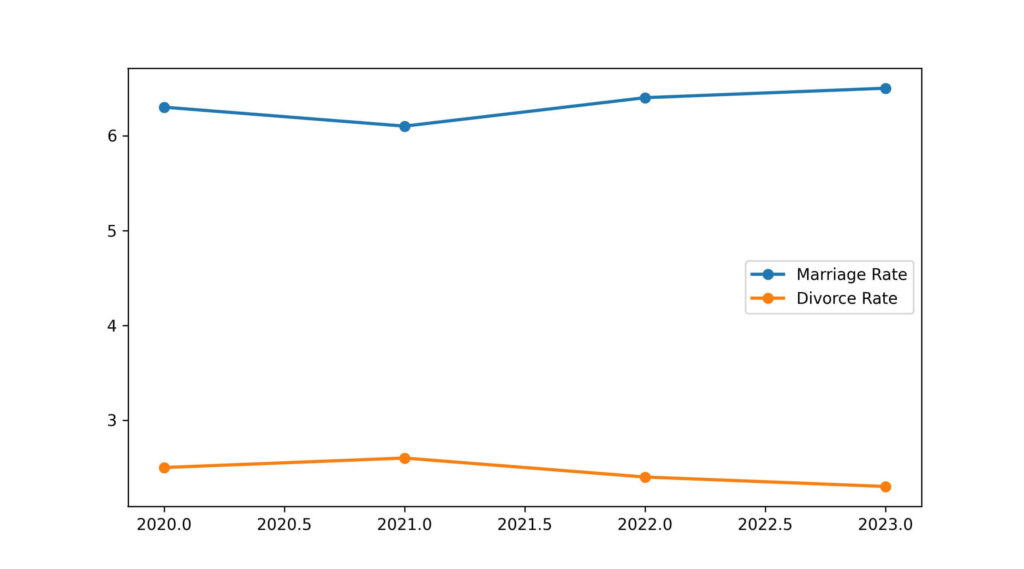
In North Dakota, the median length of marriage is about 20 years, including both ongoing and ended marriages. This aligns closely with the national average for first marriages. So, in North Dakota, couples can look forward to two decades of marital bliss—give or take a few arguments.
| Age Group (Years) | U.S. Divorce Rate per 1,000 Married Women (2021) | Key National Trend Observations | North Dakota Overall Divorce Rate (Recent Estimates) |
|---|---|---|---|
| 15-24 | 19.7 | Highest Rate. Divorce is most likely for those who marry young nationally. | 4.7 per 1,000 women aged 15 and over (Refined Rate, 2018) |
| 25-34 | 16.3 | High rate, though declining for younger generations nationally. | 2.6 per 1,000 total population (Crude Rate, 2021) |
| 35-44 | 14.9 | Marriages that last the median duration (8 years) often place individuals in this age bracket for their divorce. | (Consistently one of the lowest rates in the U.S.) |
| 45-54 | 14.1 | Rate is stable and lower than younger groups. | |
| 55-64 | 11.8 | Part of the “Gray Divorce” trend; the rate for this older group has risen significantly since 1990. | |
| 65 and older | 5.5 | Lowest rate, but fastest-growing demographic for divorce since 1990. |
Divorce Rate in North Dakota in 2025
- Low Crude Divorce Rate. North Dakota consistently reports one of the lowest crude divorce rates in the U.S., around 2.7 divorces per 1,000 residents—below the national average.
- Mixed Grounds for Divorce. The state allows both no-fault (irreconcilable differences) and fault-based grounds, including adultery, extreme cruelty, willful desertion, and felony conviction. Because nothing says “modern divorce” like keeping six old-school ways to blame your spouse.
- Flexible Residency Requirement. A spouse must be a resident for six consecutive months before the decree, not before filing. This allows new residents to start the process immediately.
- Equitable Distribution. Marital assets and debts are divided fairly, but not necessarily 50/50. Courts consider various factors to reach what they deem equitable. Fair means “whatever the judge feels like,” apparently.
- No Mandatory Waiting Period. North Dakota doesn’t impose a statutory waiting period, so uncontested divorces can finalize quickly—often in 1–3 months.
- Fault Can Influence Alimony. Even though most divorces are no-fault, a spouse’s misconduct may impact spousal support if it significantly affected the other’s earning potential. Just in case you wanted your ex punished for being terrible.
- Low Daily Filings. With a small population, the state averages about six divorce filings per day.
Divorce Rate in North Dakota in 2023-2024
- High Refined Divorce Rate. Despite its Midwestern reputation, North Dakota had one of the highest refined divorce rates in the U.S., tied with Nevada at ~20.1 divorces per 1,000 married women, placing it in the top five nationally.
- High Marriage Rate. About 52.4% of adults in North Dakota are married, which, combined with the high divorce rate, results in a relatively high number of dissolutions. Apparently, North Dakotans can’t decide whether to say “I do” or “I don’t.”
- Official Divorce Count. The state reported roughly 2,043 divorces in 2024, averaging six filings per day.
- Hybrid Divorce Laws. North Dakota allows both no-fault (“irreconcilable differences”) and six fault-based grounds, including adultery, extreme cruelty, and willful desertion. Because nothing screams modern efficiency like keeping all the old-school blame games alive.
- Fault Can Affect Alimony. Judges can consider marital misconduct when determining spousal support if it contributed to the marriage breakdown. Finally, a legal way to make your ex pay for being awful.
- Unique Property Valuation Date. In contested cases, marital property is valued 60 days before the scheduled trial. Courts may adjust if values change significantly after that.
- Equitable Distribution. Assets and debts are divided fairly, with a strong presumption of 50/50 in “long-term” marriages (even less than ten years counts).