
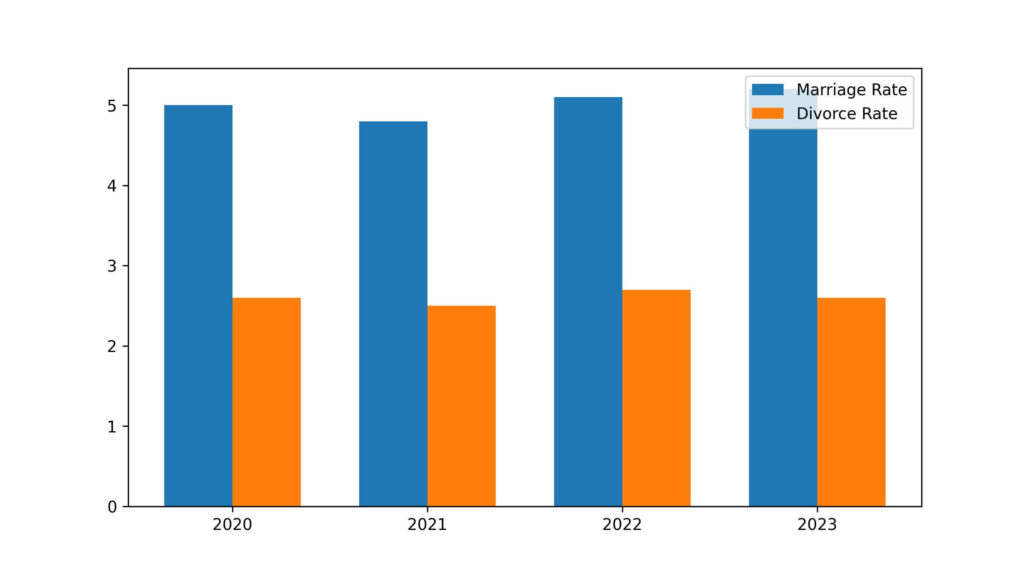
New York consistently has one of the lowest divorce rates in the U.S. The crude divorce rate is around 2.2 to 2.3 divorces per 1,000 residents, well below the national average. This places the state among the lowest nationally. New York’s low divorce rate aligns with the broader trend in the Northeast. So, in New York, marriages apparently come with a “stick together” guarantee – how quaint.
In New York, the median length of marriage is about 20 years, including both ongoing and ended marriages. This aligns closely with the national average for first marriages. So, in New York, couples can expect about two decades before testing their “happily ever after” warranty.
| Age Group (Years) | U.S. Divorce Rate per 1,000 Married Women (2021) | Key National Trend Observations | New York Overall Divorce Rate (Recent Estimates) |
|---|---|---|---|
| 15-24 | 19.7 | Highest Rate. Divorce is most likely for those who marry young nationally. | 2.2 per 1,000 total population (Crude Rate, 2021) |
| 25-34 | 16.3 | High rate, though declining for younger generations due to later marriage. | Low Refined Rate: New York’s adjusted rate is typically in the bottom 10 nationally |
| 35-44 | 14.9 | Marriages that last around the median duration (8 years) often place individuals in this age bracket for their divorce. | |
| 45-54 | 14.1 | Rate is stable and lower than younger groups. | |
| 55-64 | 11.8 | Part of the “Gray Divorce” trend; the rate for this older group has risen significantly since 1990. | |
| 65 and older | 5.5 | Lowest rate, but fastest-growing demographic for divorce since 1990. |
Divorce Rate in New York in 2025
- Low Crude Divorce Rate. New York consistently has one of the lowest crude divorce rates in the U.S., thanks to a higher median age at first marriage, higher educational attainment, and the financial barriers imposed by the state’s high cost of living.
- Late Adoption of No-Fault Divorce. New York was the last state to adopt a pure no-fault divorce ground in 2010, streamlining a process that once required proving specific fault. Better late than never – because nothing says efficiency like waiting decades to catch up with everyone else.
- Dominant No-Fault Ground. The most common legal basis for divorce is “irretrievable breakdown” of the marriage for at least six months, eliminating the need for fault-based litigation.
- Fault-Based Grounds Still Exist. Six traditional fault-based grounds – such as adultery, cruelty, and abandonment – remain, mostly used in highly contested cases. Ah yes, just in case couples need to drag out their misery, the old-school drama is still available.
- No Mandatory Waiting Period. There is no required “cooling-off” period. Uncontested divorces can sometimes be finalized in as little as six weeks once paperwork is complete and the six-month breakdown period is met.
- Equitable Distribution (Not 50/50). Marital property is divided fairly, but not necessarily equally. Judges consider factors like marriage length and future financial circumstances. Because who really wants a simple half-and-half when you can have a judge’s “fairness” opinion decide your fortune?
- Complex Residency Requirements. To file, a spouse must meet one of several residency criteria, ranging from one to two years depending on where the marriage occurred and grounds for divorce.
- Sole Supreme Court Jurisdiction. Only the New York Supreme Court can grant a divorce. Family Court handles related issues like child support and custody but cannot issue the final Judgment of Divorce.
Divorce Rate in New York in 2024
- Among the Lowest Divorce Rates Nationally. New York consistently ranks among states with the lowest crude divorce rates. In 2024, the estimated rate was around 2.3 per 1,000 residents, below the national average of ≈2.5.
- Low Rates Correlate with Demographics. Strong socioeconomic factors contribute: a higher median age at first marriage and a large percentage of residents with advanced degrees. Apparently, waiting to grow up and getting a diploma magically keeps couples together.
- Pure No-Fault Divorce. Since 2010, New York requires only a sworn statement that the marriage has “broken down irretrievably” for at least six months. No messy fault proof is needed in most cases.
- Fault Still Legally Exists (Rarely Used). Adultery, cruelty, and abandonment are recognized but seldom invoked due to difficult and expensive proof. Because everyone loves dragging spouses through a courtroom drama over something that barely matters.
- Financial and Custody Issues Must Be Settled First. Judges cannot finalize a divorce until all property, spousal support, and child custody matters are resolved, either by agreement or court order.
- Mandatory Financial Guideline Updates (2024). Statutory income caps for child support ($183,000) and spousal maintenance ($228,000) increased, applying the official formulas to higher earners. Nothing says romance like recalculating alimony formulas every few years.
- Extreme Geographic Variation. Low statewide rates mask local differences: NYC and Ithaca have some of the lowest divorce rates, while counties like Ulster, Niagara, and Onondaga report significantly higher rates.
- No Mandatory Waiting Period (After Issues Are Settled). Once financial and custody matters are resolved, there is no mandatory cooling-off period before the final Judgment of Divorce.
Divorce Rate in New York in 2023
- Among the Lowest Divorce Rates Nationally. New York consistently ranks among the states with the lowest crude divorce rates, estimated at 2.2–2.5 per 1,000 residents – at or below the national average.
- High Cost of Divorce. Divorces are expensive, often ranging from $15,600 to over $23,000 for cases involving children. Because nothing says “love lasts forever” like a financial barrier of tens of thousands of dollars.
- No-Fault Divorce Standard (Since 2010). The most common ground is no-fault: the marriage has suffered an “irretrievable breakdown” for at least six months.
- Seven Legal Grounds Exist. New York recognizes seven grounds, including the no-fault option and six fault-based grounds such as adultery, cruelty, and abandonment. Just in case you wanted your divorce to feel like a courtroom thriller.
- No Mandatory Waiting Period. There’s no “cooling-off” period, so uncontested divorces can finalize in 3–6 months, depending on court schedules.
- Equitable Distribution for Property. Marital property is divided fairly, not automatically 50/50, though equal splits are common. Because leaving your future to a judge’s sense of fairness is way more fun than math.
- Complex Residency Rules. One spouse must meet specific residency requirements – typically one or two years depending on marriage location and grounds – before filing.