
Minnesota consistently reports a low divorce rate compared to most U.S. states. The crude divorce rate is around 2.6 divorces per 1,000 residents. When measured per 1,000 married women, the state’s rate is about 10.9, placing it among the lowest nationally. Overall, Minnesota marriages appear quite stable. So, in Minnesota, love lasts – or at least the paperwork mostly stays in the drawer.
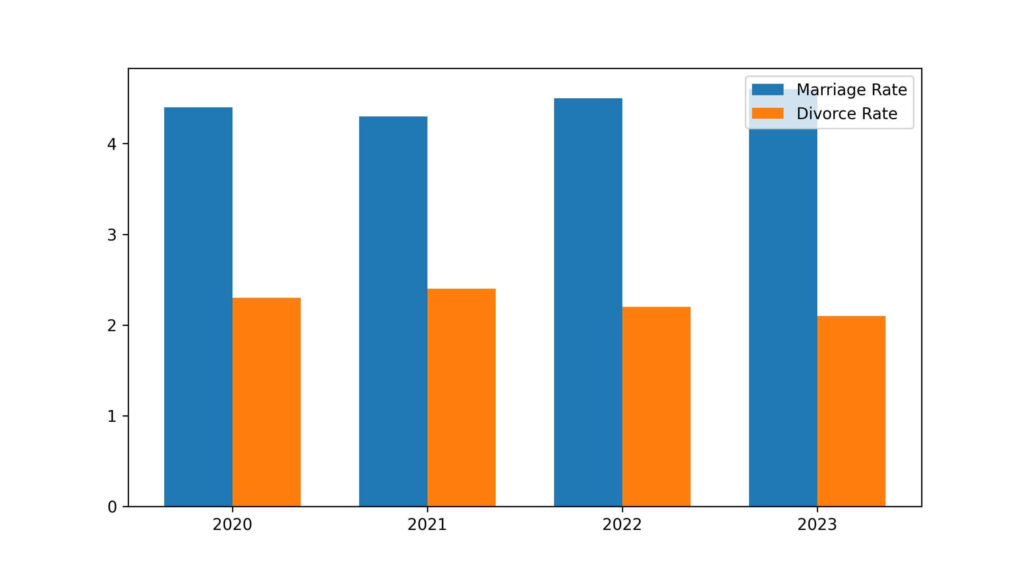
In Minnesota, the median length of marriage is about 21.4 years. This includes both ongoing marriages and those that have ended in divorce. So, Minnesotans clearly have a knack for sticking together – at least long enough to celebrate two decades of wedded “joy.”
| Age Group (Years) | U.S. Divorce Rate per 1,000 Married Women (2021) | Key National Trend Observations | Minnesota Overall Crude Divorce Rate (Recent Estimates) |
|---|---|---|---|
| 15-24 | 19.7 | Highest Rate. Young age at marriage is the most significant national risk factor. | 2.6 per 1,000 total population (2019/2021 estimates) |
| 25-34 | 16.3 | High rate, but dropping among younger generations due to later marriage. | (Consistently lower than the national average.) |
| 35-44 | 14.9 | The median duration of first marriages that end in divorce is nationally about 8 years, placing many divorces in this age window. | |
| 45-54 | 14.1 | Rate is stable and lower than younger groups. | |
| 55-64 | 11.8 | Part of the “Gray Divorce” trend; the rate for this group has risen significantly over the last few decades. | |
| 65 and older | 5.5 | Lowest rate, but fastest-growing demographic for divorce since 1990. |
Divorce Rate in Minnesota in 2025
- Among the Lowest Divorce Rates: Minnesota consistently ranks near the bottom nationally, with an estimated 10.9 divorces per 1,000 married women – well below the national average.
- Reasons for Low Rates: High median age at first marriage, strong educational attainment, and higher household incomes all contribute to marital stability. Apparently, smart, rich, and slightly older Minnesotans just can’t mess up a marriage.
- Pure No-Fault Divorce: The only legal requirement is an “irretrievable breakdown” of the marriage – proof of fault isn’t needed.
- Fault Doesn’t Affect Finances: Courts generally ignore marital misconduct when dividing property or determining custody, unless assets were wasted (e.g., gambling or affairs). Because nothing says fairness like ignoring all that juicy drama… except the part about squandering money.
- Equitable Distribution, Not 50/50: Property and debts acquired during the marriage are divided fairly, not necessarily equally. Courts consider length of marriage, contributions, and future earning potential.
- Residency & Waiting Periods: At least one spouse must have lived in Minnesota for 180 days before filing. Uncontested divorces require a minimum 31-day waiting period after serving the responding spouse. Just half a year in the state and a month of waiting, and voilà – your marriage can officially expire.
Divorce Rate in Minnesota in 2024
- Low Refined Divorce Rate: Minnesota ranks among the states with the lowest refined divorce rates. In 2022 (published 2024), it recorded approximately 10.91 divorces per 1,000 married women, placing it in the national bottom quartile.
- Low Crude Divorce Rate: The crude divorce rate in 2024 was about 2.0 per 1,000 residents, below the national average of 2.5. Because apparently, Minnesota residents just don’t know how to get divorced.
- Pure No-Fault State: Divorce requires only an “irretrievable breakdown” of the marriage – no proof of fault needed.
- Fault Is Irrelevant: Courts cannot consider marital misconduct (adultery, cruelty, etc.) when dividing property or awarding alimony; decisions are based solely on financial factors. Sure, ignore all that messy betrayal – let’s just crunch the numbers.
- Long Residency Requirement: At least one spouse must have lived in Minnesota for 180 days before filing.
- Equitable Distribution Standard: Property and debts acquired during marriage are divided fairly, not automatically 50/50, considering factors like contributions and future earning potential. Because nothing says fairness like splitting your stuff however the judge sees fit.
- High Marriage, Low Divorce: About 51.7% of adults are married, combining high marriage rates with low divorce rates—indicative of strong marital stability.
Divorce Rate in Minnesota in 2023
- Low Crude Divorce Rate: Minnesota’s crude divorce rate for 2023 was around 2.5 per 1,000 residents, slightly below the national average. Low marriage rates also contribute to the lower crude divorce figures.
- Excluded from CDC Data: The CDC excludes Minnesota from national crude divorce rate calculations, making precise comparisons difficult. Because why make things easy when you can just pretend Minnesota doesn’t exist?
- Pure No-Fault State: Divorce only requires an “irretrievable breakdown” of the marriage; proving fault or misconduct (adultery, cruelty, etc.) is unnecessary.
- Fault Irrelevant in Court Decisions: Courts cannot consider marital misconduct when dividing property or awarding alimony; only financial and equitable factors matter. Just ignore all that juicy drama – money talks, feelings don’t.
- Long Residency Requirement: At least one spouse must have lived in Minnesota for 180 days (six months) before filing.
- Mandatory Waiting Period: After serving initial documents, the final decree generally cannot be issued until 120–180 days have passed, depending on the case. Because nothing says efficiency like a half-year intermission before your marriage can officially expire.
- Equitable Distribution Standard: Marital property and debts are divided “justly and equitably,” not automatically 50/50. Courts consider contributions, length of marriage, and other factors.
- Alimony Based on Need and Marriage Length: Spousal maintenance is often temporary for shorter marriages and may be permanent for marriages lasting 20+ years, calculated according to need and duration.