
Idaho’s divorce rate is generally high compared to the national average. Its crude divorce rate is about 3.4 to 3.5 divorces per 1,000 residents, placing it well above most states. This consistently ranks Idaho among regions with a notably elevated divorce frequency. Other measures, like the refined rate, vary across sources but still reflect frequent divorce filings. Because apparently nothing brings people together in Idaho quite like deciding to split up.
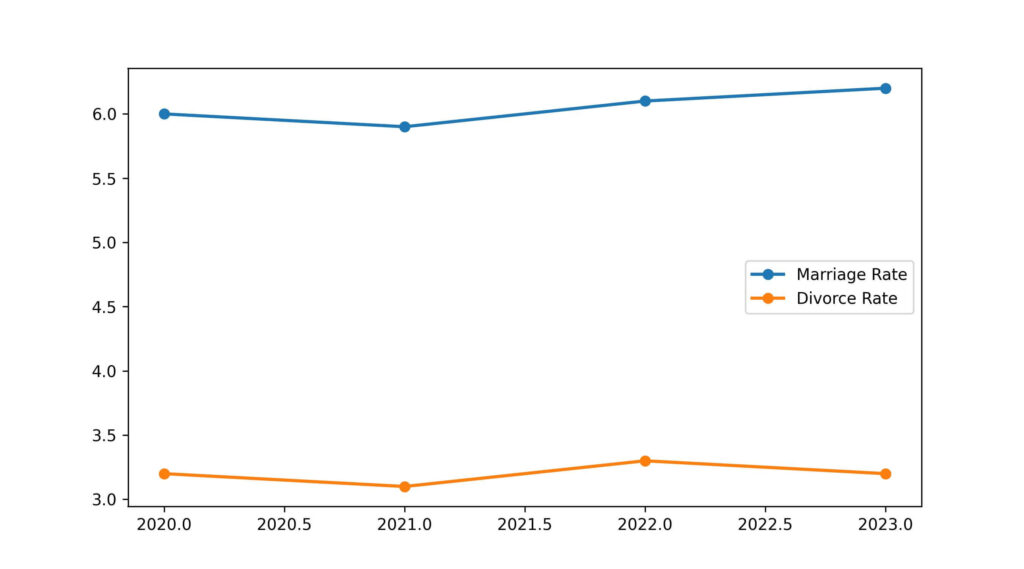
In Idaho, the median length of all marriages, including intact and ended, is about 18.6 years, slightly below the national median of 20 years. For marriages that end in divorce, the median duration is much shorter, around 6.3 years, indicating many marriages dissolve quickly. Because apparently in Idaho, some couples can last decades, but others can’t even make it past a few fishing seasons.
| Age Group (Married Women) | Projected Divorce Rate (Per 1,000 Married Women) | Key Trend in Idaho |
|---|---|---|
| Ages 15–24 | 17.8+ | Highest Risk: Marrying at a young age is a major factor in Idaho’s overall high divorce rate, making this the highest-risk group. |
| Ages 25–34 | 17.2+ | High Risk: This group often experiences divorce in the early years of marriage, exacerbated by a high number of young marriages in the state. |
| Ages 35–44 | 14.5 | Above Average: Rate begins to decline as marriages mature, but still represents a significant portion of divorces. |
| Ages 45–54 | 13.5 | Moderate Rate: Represents divorces in middle age, often concerning established families and assets. |
| Ages 55 and Older | Increasing Rate (“Gray Divorce”) | Divorce rates among older adults have increased nationally. While a smaller proportion of Idaho’s population is this age, the trend still holds true. |
Divorce Rate in Idaho in 2025
- High Crude Divorce Rate. Idaho historically ranks among U.S. states with higher divorce rates. In 2021, the crude divorce rate was about 3.4 per 1,000 people, well above the national average of ~2.4–2.5.
- Mixed Fault/No-Fault State. While nearly 99% of divorces are no-fault (“irreconcilable differences”), Idaho allows fault-based grounds such as adultery, extreme cruelty, or willful neglect/desertion. Apparently, you can blame your spouse if you really feel like it.
- Fault Can Affect Spousal Support. Courts may consider proven fault when awarding alimony to the “innocent” spouse, though it usually does not affect property division.
- Strict Community Property Rules. Idaho is one of only nine states following Community Property Law, meaning most assets and debts acquired during marriage are divided 50/50, regardless of ownership. Because nothing says “fair” like a mandatory 50/50 split.
- Minimal Residency and Waiting Periods
- Residency: Only one spouse must live in Idaho for six weeks before filing.
- Waiting Period: Judge can sign the final decree 21 days after petition is served, one of the shortest in the U.S.
- High Female Filing Rate. Around 65% of divorce petitions are filed by women, according to state statistics. Seems like someone’s doing all the paperwork.
- 90-Day Delay for Children. If minor children are involved, courts may delay proceedings up to 90 days to explore reconciliation or require attendance at a Focus on the Children class.
Divorce Rate in Idaho in 2024
- Low Refined Divorce Rate. Idaho had a refined divorce rate of 11.2 per 1,000 married women, ranking 48th lowest in the U.S. This suggests that established marriages tend to be relatively stable.
- High Crude Divorce Rate Paradox. Despite the low refined rate, Idaho’s crude divorce rate is 3.4 per 1,000 residents, above the national average of 2.5.
Because nothing says “stable marriages” like high overall divorce numbers. - High Marriage Rate. Around 54.9% of adults are married, which inflates the total number of divorces each year.
- Declining Long-Term Trend. From 2012 to 2021, Idaho’s divorce rate fell 27%, from 4.8 to 3.5 per 1,000 residents.
So, yes, divorces are slowly becoming less of a hobby here. - Community Property State. Idaho is one of only nine U.S. states with Community Property laws, meaning all assets and debts acquired during marriage are typically split 50/50.
- Income from Separate Property Counts. Income, rents, and profits from separate property (owned before marriage or received as gift/inheritance) are usually treated as community property, unless both spouses agree otherwise in writing. Because apparently your pre-marriage money magically becomes joint property.
- Women Initiate Most Divorces. In 2022 data, 65.5% of divorces were filed by women, compared to 34% by men.
- No-Fault Divorce Dominates. The primary legal ground is no-fault, citing “irreconcilable differences.”
Divorce Rate in Idaho in 2023
- High Crude Divorce Rate. Idaho’s crude divorce rate was about 3.4 per 1,000 residents, well above the national average of 2.5.
- Long-Term Decline Despite High Rate. Over the decade leading to 2023, the divorce rate fell 27%, despite remaining above average.
So yes, divorces are dropping… but only slightly less than you’d expect. - Most Filings Are by Women. In 2022, women initiated roughly 65.5% of divorces, nearly twice as many as men.
- Short Mandatory Waiting Period. The minimum waiting period is 20 days from service or response to finalization – one of the shortest in the U.S. Apparently, Idaho thinks divorce should be quick, like fast food.
- Community Property State. Idaho is one of only nine states with Community Property laws, so assets and debts acquired during marriage are generally split 50/50.
- Hybrid Grounds State. While most divorces are no-fault (“irreconcilable differences”), fault-based grounds such as adultery, extreme cruelty, or desertion are still recognized. Because nothing says “marital bliss” like a list of reasons to blame your spouse.
- Six-Week Residency Requirement. One or both spouses must have lived in Idaho for at least six weeks immediately before filing.