
Colorado’s divorce rate is generally 2.8 to 3.0 divorces per 1,000 residents. This crude rate places the state in a moderate to slightly above-average range nationally. Colorado consistently reports a divorce rate that is a bit higher than the national average. Overall, the state falls into a middle-high category compared to others. Because nothing complements those scenic mountain views like paperwork to end your marriage.
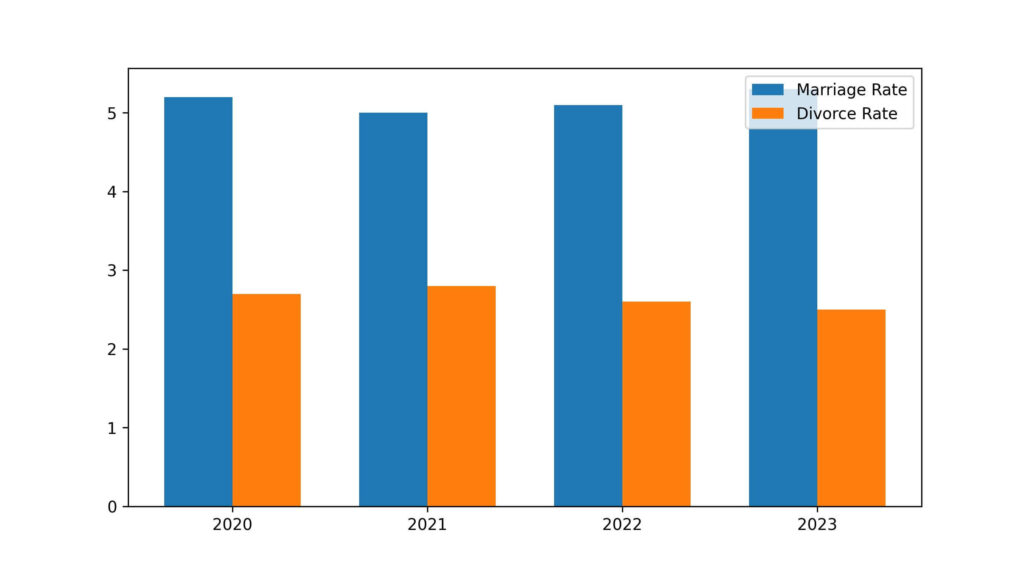
In Colorado, marriages that end in divorce have a median duration of about 17.9 years, placing the state among those with shorter marriage lengths. This is slightly longer than Texas and Alaska but comparable to Oklahoma. Because apparently in Colorado, even the mountains can’t hold a marriage together forever.
| Age Metric / Group | Colorado Trend & Statistic | Key Insight |
|---|---|---|
| Median Age at Divorce | 45.5 for Males / 42.6 for Females | The median age for divorce in Colorado is slightly younger than the national median (46.1 for men and 44.1 for women). |
| Young Marriages (Under 25) | Highest Risk Factor | Marrying at a relatively young age is cited as a major risk factor for divorce in Colorado, indicating the highest age-specific divorce rate is in this group. |
| Ages 25–39 (Spouses) | High Percentage | Nationally, this age group accounts for about 60% of all divorces, a trend generally mirrored in Colorado for early and mid-life dissolution. |
| Ages 50 and Older | Increasing Rate (“Gray Divorce”) | Colorado follows the national trend of a rising divorce rate for older couples, often Baby Boomers in long-term marriages. This group accounts for the lowest number of divorces but the highest growth rate. |
| Ages 75 and Older | Lowest Risk Group | This age group accounts for the lowest percentage of divorces, as marriages that reach this point are highly likely to remain intact. |
Divorce Rate in Colorado in 2025
- Higher-than-Average Divorce Rate. Colorado’s divorce rate is slightly above the national average, with annual filings stable between 20,000–25,000 in recent years.
- High Marriage Rate. The state also ranks among the highest in marriage rates, which naturally increases the pool of divorces. More weddings, more divorces – because love apparently comes with a warranty.
- Short Residency Requirement. At least one spouse must reside in Colorado for 91 days before filing, a measure to prevent “divorce tourism.”
- No-Fault Only State. Divorce is granted solely on irretrievable breakdown of the marriage – proof of fault like adultery or cruelty is irrelevant. Because nothing says “efficient breakup” like ignoring who was actually guilty.
- Mandatory 91-Day Waiting Period. After filing, there is a minimum 91-day wait before the court can finalize the divorce, one of the quickest in the U.S.
- Equitable Distribution. Marital property and debts are divided fairly according to the court, often 50/50 but adjustable for each couple’s circumstances. Fairness first – because splitting things exactly down the middle would be too simple.
- High Rates in Specific Counties. Divorce filings are highest in areas like El Paso County (military presence) and Denver County (dense population).
- Gray Divorce Trend. Divorces among adults over 50 are rising, linked to longer life expectancy and greater financial independence.
Divorce Rate in Colorado in 2024
- Above-Average Divorce Rate. Colorado’s crude divorce rate was 2.8 per 1,000 residents, above the national average of ~2.5.
- High Marriage Rate Paradox. With one of the nation’s highest marriage rates (~20.9 per 1,000 women), many couples tie the knot – and many also untie it. Apparently, the more you marry, the more practice you get in divorcing.
- High Total Filings. About 23,291 divorce petitions were filed in 2024, making up roughly 75% of all domestic relations cases in state courts.
- Highest Filings in El Paso County. The 4th Judicial District (El Paso & Teller Counties) recorded 4,267 divorces, the state’s highest. If you live in El Paso County, statistically you’re just a little more committed to paperwork than to marriage.
- Pure No-Fault State. Divorce requires only that the marriage is “irretrievably broken”; proving fault like adultery is irrelevant.
- 91-Day Waiting Period. A mandatory minimum of 91 days must pass after the petition is served before finalization. Because nothing says “moving on” like a three-month court-mandated pause.
- Equitable Distribution. Marital assets and debts are divided fairly by the court, often 50/50 but adjustable based on circumstances.
Divorce Rate in Colorado in 2023
- Above-Average Divorce Rate. Colorado’s crude divorce rate was 2.9 per 1,000 residents, above the national average of ~2.4.
- High Volume of Filings. Approximately 23,074 divorce petitions were filed statewide. Because apparently, marrying a Coloradan comes with a complimentary paperwork subscription.
- Pure No-Fault State. The only requirement for divorce is that the marriage is “irretrievably broken”; marital misconduct like adultery is irrelevant.
- Mandatory 91-Day Waiting Period. Divorce cannot be finalized until 91 days after the petition is filed and served. Nothing says “move on quickly” like a three-month mandatory court nap.
- Residency Requirement. Either spouse must have lived in Colorado for at least 91 days before filing. Children must reside 182 days for custody jurisdiction.
- No Separation Requirement. Spouses do not have to live apart before filing for divorce. Colorado skips the awkward “sleep in separate rooms” stage and goes straight to legal paperwork.
- Marital vs. Economic Fault. While personal fault is ignored, financial misconduct can affect property division. Reckless spending or wasting marital funds may shift the award toward the “innocent” spouse.
- Equitable Distribution. Marital property is divided fairly by the court. Equal (50/50) splits are common but not guaranteed.